I am delighted to announce that I have three new poems ‘The Red Motorbike’, ‘Gladesville Bridge’ and ‘Frozen Ravioli’ appearing in Issue 23 of the Aoetearoa (New Zealand) based journal Catalyst. If you are close to Sydney you can hear me read these poems, and perhaps one or two more, at the Australian launch on Saturday:
Catalyst Literary Arts Journal: Volume 23 Australian launch will be held in Sydney on Saturday 11 July, 3-5pm at ellipsis Gallery, Level 1, 41 Crown Street, Woolloomooloo NSW 2011.
Things are getting real. I’ve signed the contract for my third collection, The Office of Literary Endeavours, with 5 Islands Press and, this weekend, I will be going through the final edits. While most of the poems in the collection have been published in various magazines, journals and anthologies over the past decade or so it will be great to see them together in a single collection.
It was a great feeling to wake up on New Year’s Day to find four poems from my upcoming collection, The Office of Literary Endeavours, published on the the Lothlorien Poetry Journal blog. Many thanks for editor Strider Marcus Jones for publishing ‘cutting the grass’, ‘the other city’, ‘consolidation’ and ‘Northern Stone’.
There are some journals were there is that extra bit of excitement when you receive an acceptance. Plumwood Mountain is one of those journals. The journal is subtitled An Australian Journal of Ecopoetry and Ecopoetics and it is this clearly stated political stance that makes the journal and the work in it so important.
My poem ‘feral green marketing’, which appears in issue 7:1, is the second poem I have written in a genre which I “invented” some time ago (the first ‘Written Under Duress was published in Australian Latino Press some years ago https://australianlatinopress.blogspot.com/2014/05/written-under-duress-mark-roberts.html). The genre, which doesn’t have a name, takes the form of three stanzas with each stanza having its own title. The overall poem title is a combination of all three stanza titles. Beyond that I guess I am still working on the rules.
‘Blue Water Tank’ is a short prose piece from the Lacuna manuscript which I am particularly fond of. It is a personal piece but one that I have always liked and I am so pleased that it has found a home in Re-Side Issue Two along with some other amazing work. ‘Blue Water Tank’ can, in some ways, be seen as a companion piece to ‘Place Burial’ which appeared in the Ramon Loyola edited Issue 3 of Pink Cover Zine (https://printedshadows.wordpress.com /2019/05/08/place-burial-appears-in-pink-cover-zine-issue-3/).
After travelling down from the Blue Mountains last night through the Oberon Plateau, I woke in Canberra this morning looking forward to reading with Marianne Boruch at That Poetry Thing That Is On At Smith’s Every Monday (7pm at Smith’s Alternative, 76 Alinga Street, Canberra). I will be reading poems from Concrete Flamingos as well as work from my new manuscripts. If you are in Canberra I would love to see you tonight!
I haven’t sent much work out over the last 12 months but I have been fortunate to have a number of pieces appear in various magazines and anthologies. Many of these have been from the Lacuna manuscript which I am still working on 18 months after I originally thought it was completed. One of the pieces in Lacuna is a poem inspired by a visit to Yaranigh’s grave just outside of Molong NSW.
Yaranigh was a Wiradjuri man caught up in the rapid dispossession of Aboriginal lands in the first half of the 19th century. Yaranigh straddled both Aboriginal and European cultures and worked on expeditions with with early colonial ‘explorers’ through NSW and Queensland, acting as a guide and interpreter as the expedition moved through different Aboriginal nations. The most famous of these expeditions was with Sir Thomas Mitchell’s expedition to find the mythical inland sea. On his death Major Mitchell gave him a formal European burial while his own people surrounded the graves with ceremonial carved trees. This combined tribute made me think of delicate situation Yaranigh must have found himself in and how he might have attempted to limit the impact of the Europeans by carefully negotiating passage away from scared sites and areas of importance to local people.
Landmarks is described as an anthology which tackles the theme of Landmarks: critical or celebratory, watershed moments or turning points in history, culture or in relationships. It seemed to me that my poem about Yaranigh’s grave was a good fit for such an anthology. Unfortunately the anthology was looking for microlit and ‘Yaranigh’s Grave’ was a poem. So, not for the first time, I attempted to take a work in one genre and rework it into another. The version that appears in Landmarks is therefore a different work than the one that exists in the Lacuna manuscript. While I still think the poem is a more powerful piece I am still extremely proud that the micro prose version of ‘Yaranigh’s Grave’ has appeared in Landmarks.
Theresa Hak Kyung Cha’s Dictee; Dictee Takes the Stage. Photograph by Soomi Kim. The cover of Postcolonial Text Issue 12: No.1
I am very pleased to have had ‘The Office of Literary Endeavours: Maree’ published in the on-line journal Postcolonial Text. This poem is an interesting one for me as it grew out of a novel I’m attempting to write. As part of my research I was reading a lot of poetry in translation. I found myself increasingly wanting to get ‘behind’ the translation to the poem – to read different translations of the same poem and to use online translation tools and dictionaries to create my own literal translations.
One of the poets who caught my attention during this time was the Spanish poet Luis Cernuda. Cernuda was born in Seville in 1902 and during the Spanish Civil War he found himself forced into exile when he was unable to return from giving a series of lectures in England. Openly homosexual and antifascist Cernuda spent the rest of his life in exile, dying in Mexico in 1961. It was while reading and playing around with Cernuda’s work in translation that I started writing some poems in a style that seemed to me to have a feeling of being translated. This is a hard thing to describe but I guess it is where you look at the multiple meanings behind each word and try and understand different ways of capturing the same idea or image.
One of the results of this exercise was ‘The Office of Literary Endeavours: Maree’ and you can read it here:
I’m excited to find my short poem, “I can be tight and nervy as the top string on a violin”, which is based on a line from a Sylvia Plath short story, has found its way into the latest issue of Tincture (Issue 17).
Tincture is an unusual journal as it is available in ebook formats (EPUB and kindle) only, no print or on-line versions. There are, a number of advantages to this strategy, Tincture can produce a journal which is available for sale to anyone with an internet connection and a device running freely available software. It is also able to sell the journal, something which is difficult for most online journals running on blogging platforms. Finally it can sell each issue at a fraction of the cost of a compatible print version. By establishing a income stream Tincture is also able to pay its contributors, something all writers should appreciate. There is, of course, on the other hand the issue of accessibility. One can’t simply click on a link, or order a hard copy, and start reading. But all in all Tincture is a innovative concept in the Australian literary scene, which has been running for seventeen issues now, and which deserves our support.
If the fact that Issue Seventeen contains my poem isn’t enough to convince you to click on http://tincture-journal.com/buy-a-tincture/ and buy it, here is the table of contents for the issue:
Editorial, by Daniel Young Some Days, by Rebecca Jessen Moederland: Part One: I’m Not From Around Here, by Johannes Klabbers Political Reflections: The Day Trump Won, by Alexandra O’Sullivan The Need for Poetry, by Mindy Gill Water Lily, by Douglas W. Milliken Ethanol, Eschar, by Charlotte Adderley WWJD? by Nathanael O’Reilly Compass, by SJ Finn Plum, Flower, by Eileen Chong Shoes That Go Krtz-Krtz, by Tamara Lazaroff Beach Road, by Thom Sullivan Great Expectations, by Denis Fitzpatrick Avid Reader, by Rosanna Licari Running Away from the Circus, by Philip Keenan Spider, by Ailsa Dunlop From ‘Autobiochemistry’, by Tricia Dearborn Our Mate, Cummo, by Dominic Carew “I can be tight and nervy as the top string on a violin”, by Mark Roberts Venus, by Grace Jervis Last Post, by Aidan Coleman Fighting for Breath, by Paul Threlfall Combination Soup, by Pam Brown You Are Cordially Invited, by Sean Gandert
So click away and you could be reading the latest Tincture in a matter of minutes!
I’m looking forward to reading with Melinda Louise Smith and listening to A Walk through Gaza (Poetry from Palestine) this coming Wednesday night at the Don Banks Museum, 6 Napier Street North Sydney from 7.30 pm. I will be reading poems from my new manuscript Lacuna as well as some from my last collection Concrete Flamingos. Many thanks to Danny Gardner for inviting me.
The Basil O’ Flaherty is an interesting newish on-line journal run out of the US by J.K. Shawhan. In the best tradition of small literary journals it was established by a writer wanting to create outlets for the sort of writing and artwork she was interested in – 30 years ago it would have been gestetnered or photocopied, these days it is a free online journal.
Along with its normal editions The Basil O’ Flaherty is also devoting sections to feminist poetry and poems in translations. It will be interesting to see how these sections develop over the coming months.
My block-poem ‘Shark’ has appeared in the on-line journal Otoliths Issue 43. Otoliths is one of of those journals which flies a little under the radar but which has a rich history and continues to play an important role both locally and internationally. Otoliths is edited by the New Zealand born Mark Young who curently lives in Queensland and who has been publishing poetry for over 50 years. He describes the journal as publishing “e-things, that is, anything that can be translated (visually at this stage) to an electronic platform”. As a result Otoliths contains an interesting mix of poetry and prose ranging from the almost traditional to the experimental including some very fine visual poems.
I have described ‘Shark’ as a ‘block-poem’. It is a form that I have been playing around with a little recently where what would normally be a conventional prose poem is ‘forced’ into a contained space – a square, rectangle, circle etc. ‘Shark’ is the first of these poems that I have sent out and is based on a childhood memory of an old creek at the end of the street that had been encased in concrete and was referred to as “the canal”. It basically became the local dumping ground and filled up with car bodies, discarded washing machines and the like. By being forced into a column ‘Shark’ takes on the appearance of a traditional newspaper story where the importance of the story could be measured in column inches – but the actual text of ‘Shark’ retains its poetic origins.
‘Shark’ can be found at http://the-otolith.blogspot.com.au/2016/08/mark-roberts.html. While you are there make sure to lose yourself in the reach archive of work that can be found at the Otoliths site. If you haven’t been there before you are in for a treat.
Forgetting is so Long: An Anthology of Australian Love Poetry edited by Robbie Coburn & Valli Poole. Blank Rune Press 2016
Love is so short, forgetting is so long. ………………………… – Pablo Neruda
.
When we think of anthologies were generally think of larger books with lots of pages so it was exciting to be asked to contribute to a chapbook anthology of Australian love poems. Some years ago I had some poems in the Inkerman & Blunt Australian Love Poetry anthology. That was a huge, diverse and ultimately uneven anthology (as anthologies of that size tend to be). Forgetting is so Long is the opposite – it is a small, beautifully constructed chapbook and it features love poems by men. When I was submitted my poems to Robbie Coburn I was unaware that the anthology would be purely love poems by men but I have been pleasantly surprised by the result and the company in which my two poems have landed. There is a hint here of a different masculinity, something that deserves to be explored in greater depth.
Along with my work Forgetting is so Long contains poetry by Ashley Capes, Robbie Coburn, Glenn Cooper, Phillip Hall, Ramon Loyola, Pete Spence, David Ellison, Andy Jackson, Ariel Riveros Pavez, Kenneth Smeaton and Les Wicks. It is available from Collected Works Bookshop in Melbourne or you can contact the publisher for details on how to acquire a copy blankrunepress@gmail.com
I have been waiting over twenty years for the call from Hollywood. I knew it would come, it was just a question of when. You know the call: “Hi Mark, We’ve read your micro-fiction and we want to make it into a movie. Yes a three hour blockbuster with Tilda Swinton, Charlotte Rampling and Harvey Keitel”. Well I’m still waiting for that call but I did receive an email from the wonderful Spineless Wonders to let me know that my small micro-fiction piece ‘City Circles’ was being made into a very short video by Emily Twomey and will be screened as part of the Beams Arts Festival at Chippendale this Saturday. The piece will be part of Spineless Wonders #storybombing initiative. #storybombing takes place at 15A Dick St, Chippendale NSW and I believe that the videos will also appear on the festival show reel.
.
Bluepepper, edited by Justin Lowe, is one of my favourite online poetry journals so it is always exciting to have a poem accepted by them. ‘The Age of Rubbish’ is a poem about the recent history of Morrison Bay on the Parramatta River near where I grew up.
Hitting the Wall by David Foster Penguin 1989. This review was first published in Australian Book ReviewIssue 109 April 1989.
I have often found myself feeling a little frustrated after reading a David Foster novel. While never doubting his ability as a writer, the convolutions of his narrative have, more than once, overshadowed his undeniably fine prose. His latest book Hitting the Wall, a collection of two novellas, allows us the opportunity to examine how Foster handles the more urgent needs of this much shorter form.
Hitting the Wall also allows us to see two different stages of Foster’s development as a writer. The first novella, ‘Eye of the Bull’, was written in 1986, while the second, ‘The job’, is a much earlier work having been written in 1973 and having first appeared in Escape to Reality in 1977. Both these novellas share similar concerns. Wilson, the central character of ‘Eye of the Bull’, is obsessed with running. In fact he spends most of the novella running, both physically and emotionally. Like a true addict he believes that he can keep his addiction under control, whereas his addiction gradually overtakes him, and this will cost him his job, his health and eventually his family.
Billy, the small time crim in ‘The Job’, is unable to break out of the lifestyle which has already landed him once in gaol. Unable to entertain the thought of a conventional job, he lives off his wits, content for the most part to drift from one situation to the next, making little effort beyond his regular nights Of safe breaking. Billy, in fact, is addicted to ‘the job’, describing how, when he was on a job, his heart would beat ‘as though I had dosed up on methedrine, attuned to the spirit of the night’.
‘The Job’ opens as Billy is released from gaol. A few hundred metres from the gates he accepts a lift from Brian in a beaten up old car. Brian soon talks Billy into taking part in a series of robberies. But as time passes with nothing to show but an amateurish attempt on the local RSL, we realise that Billy is simply a plaything for Brian — that a game is being played out that has been played out many times before. Billy himself recognises this early on when he thinks:
You tell yourself you’re learning, you’re changing, but you’re not learning and you’re not changing very much, except that you feel increasingly tired.
‘The Job’ is, in fact, built on repetition. Billy is befriended by Brian and when Brian disappears Billy finds himself taking his place. He begins living with Brian’s wife in Brian’s house and begins sleeping with his mistress. In the end it is the same need that Brian felt to ‘escape’ which takes Billy back to the road leading past the gaol looking for a hitchhiker just out of gaol.
Stylistically Foster has kept a tight rein over this earlier of the two novellas in Hitting the Wall. The language, at times, seems a little forced and overall I felt that ‘The Job’ could indeed benefit from one final, thorough edit. ‘The Job’ is obviously a carefully planned work and one is always aware of Foster leading the narrative in a wide circle. Halfway through the novella it became clear that he is leading us back to the beginning. ‘Eye of the Bull’, by comparison, is much more stylistically relaxed, and this has a lot to do with the subject matter. Whereas Billy in ‘The Job’ returns to his starting point, Wilson runs virtually in a straight line from beginning to end. It may also have something to do with Foster ‘s maturity as a writer. The thirteen years which separate ‘The job’ from -Tye of the Bull’ have been prolific for Foster and one can perhaps argue that the smoothness of `Eye of the Bull’ is, in part, a result of Foster’s growing confidence in his own ability.
Wilson is obviously suffering from a midlife crisis. Concerned that he is in a dead end he throws in his job and moves his family to the countryside outside a city that is obviously Canberra. The cliched rnidlife crisis tale continues when Wilson leaves his wife and family for a much younger woman. While ‘Eye of the Bull’ could easily have become a formula story of an ageing man attempting to rediscover his youth, Foster has tackled the subject with sensitivity and originality. The endlessly jogging Wilson still emerges from the novella as a pathetic character but his pathos is edged with a hint of tragic heroism.
Foster has always attempted to inject an element of humour into his work. While this humour has sometimes sat quite awkwardly in novels such as Plumbum, in ‘Eye of the Bull’ the humour grows naturally out of a situation without becoming obtrusive.
While highlighting some of his recurring concerns, the two novellas in Hitting the Wall, also provide us with an opportunity to examine how Foster has developed as a writer over the last decade or so. The ‘achievement of `Eye of the Bull’ suggests that Foster is at his best when he distances himself slightly from the text and works with a relatively uncomplicated narrative. It will be interesting to see whether Foster will continue this approach in his next novel.
Shooting Gallery: a group show featuring film and video projects, funded by the Australian Film Commission (AFC) and exhibited in association with the Australian Film Institute. It screened at the Chauvel Cinema Sydney and the Brisbane Centre Cinema. It also screened in Hobart, Melbourne, Perth and Adelaide. Review first Published in Tribune (Issue 2417), April 2 1986.
The late Lance Curtis in ‘The man You Know’ by Steven Jacobs. The film deals with a complex range of social and political questions and satirises the peculiar combination in Australian politics of “conservatism, apathy, the profit motive and rampant pragmatism.
The demise of the Sydney Filmmakers Co-operative has left a large gap in the distribution of independent films and video in Australia. But while, in the long term, there are still many obstacles to the establishment of an effective independent distribution service, for the present the Australian Film Institute (AFI) has come to the rescue with Shooting Gallery.
Shooting Gallery brings together a wide range of films and videos which have been produced with the assistance of the Creative Development, No Frills, and Women’s Film Funds of the AFC. The films are organised into nine programs which will be screened across Australia over the next few months. The films range from professional, mainstream oriented documentaries to open-ended dreamlike reminders of Super 8 film festivals.
Some, such as Red Matildas, Kemira — Diary of a Strike, Song of Ceylon and Munda Nyuringu. have been screened before. But, as independent films generally receive such brief commercial seasons, another opportunity to catch up on those you may have missed the first time round is always welcomed.
For other films, particularly those in the “Best of No-Frills Fund”, Shooting Gallery may provide the general public with one of the few opportunities to see what is happening at the grassroots level of Australian filmmaking.
Program 1 of Shooting Gallery opened with Flotsam Jetsam, an energetic and colorful song clip by Lucinda Clutterbuck. Based on dancers who had been animated to bounce and flow across the screen, the two-dimensional stick figures moved with such energy you could almost see the dancers fully formed beneath. Red Matildas, by Sharon Connolly and Trevor Graham, concluded the first program. Lots of historical footage cut with modern-day interviews created an enthusiastic and informative picture of three Australian women’s involvement with socialism and anti-fascism, beginning in the depression days of the early ’30s.
Punching Keys, by Sally Ingleton, is a highlight of Program 2. It is a dramatised documentary, questioning the application and side effects of modern office technologies on women VDU operators. The image was manipulated by the wonders of video technology to describe the depersonalisation and stresses of computer technology.
Among films to look forward to in later programs are Kay Self’s Portrait of Psyche, Steven Jacobs’ The Man You Know, Patricia L’Huede’s and Mark Mcleod’s Rapunzel in Suburbia, about the life and work of writer Dorothy Hewett.
At a period when the future of independent film-making is still under a cloud. Shooting Gallery is an opportunity not to be missed.
First Published in Editions Issue 2 September 1989
Going Down Swinging Issue 9, 1989
Distribution has always been a problem for small literary magazines. The economics of producing a literary magazine means that, in most cases, editors would have to pay one of the mainstream distributors to take on their products. Most magazines, therefore, rely on direct sales to a handful of more or less sympathetic bookshops and subscribers. Even here, however, things are not all they should be. Bookshops will generally take between 25% to 40% of the retail price of the magazine and, as most bookshops will only take magazines on a ‘sale or return’ basis, the editors only get paid for the number of issues sold (or so the theory goes). Building up a subscription list can be just as daunting.
Without the funds for effective publicity campaigns most magazines are forced to rely on ‘word of mouth’ and mentions or free ads in other magazines to attract potential subscribers.
There have been various attempts to change this situation by setting up co-operative based small press distribution networks and small press publicity campaigns. But to set up such a project costs money and the funding authorities, for the most part, seem content to hand money– out to a handful of magazines on an individual basis rather than to build up an infrastructure which would help all magazines.
Recently a group of six magazines combined resources to produce what they call ‘The Small Press Package’. This scheme is essentially a sampler: for $21.50 you get the current issues of all six mags. Presumably, once you have a copy of all the magazines you can then decide which ones to subscribe to.
The six magazines on offer are Going Down Swinging ‘a prose and poetry magazine that publishes the writing of new, unknown, and/or young writers’; On the off beat ‘a publisher of women’s short stories and a focus for continuing support of good contemporary women’s fiction’; Studio a Christian literary journal ‘publishing poems, short stories and articles from established, new and aspiring writers’; Brave New Word ‘a publisher of contemporary Australian short stories and poetry, and sometimes interviews related to Australian writing and publishing’; Writing ‘a magazine coordinated by the Victorian Community Writing Committee. Writing gives preference to unpublished, or as yet unpaid writers, and to writing groups’; and The Famous Reporter ‘a short story magazine publishing the work of both new and established writers in a wide range of styles and themes’.
One of the most ‘established’ of these magazines is Going Down Swinging which has just published its ninth issue. It was established by Myron Lysenko and Kevin Brophy in 1980 and has produced an average of one issue a year since. Like many magazines it seems to have been born out of a feeling that the existing magazines were ignoring a section of the writing and reading community. In the editorial for the ninth issue Brophy and Lysenko, along with Associate editor Nolan Tyrrel, make the point that it is through magazines like Going Down Swinging that many writers make their first contact with editors. The comment and reaction they receive can be the first steps away from keeping their work to a small circle of friends’. Going Down Swinging has therefore always had a policy of ‘reacting specifically and personally to all submissions’.
Probably as a result of this policy Going Down Swinging has become one of the more innovative magazines in Australia, consistently publishing original, interesting and non-mainstream work by new and/or unknown writers. Issue number nine is a good example of the success of this policy. The work in the issue ranges from the realism of Leah Nischler’s opening piece ‘Barbara Cartland does a bunk’ to the fast-moving prose in Doreen Sullivan’s ‘Johnny Fish-Face’ and the measured emotionalism of April Phillips’ (I’m sure that’s a pseudonym) ‘Cage, manger, rack’.
There is also some impressive poetry in this issue. Colleen Farrell’s seven poems stand out. Her opening lines are constantly a particular highlight, an example being the Plath like opening of Ten Tulips’:
‘Do you know the dying stages of a
tulip? I do I’m learning.’
I also liked Rosanne Musu’s descriptive poem ‘Ship building’ and Christine Lindberg’s ‘All that jazz’
It’s interesting to note that the majority of work in this issue of Going Down Swinging is by women. Their confident experimentation is in contrast to the generally ‘safer’ more literary work by the male contributors.
Another strength of Going Down Swinging has always been its reviews and interviews. Over the years it has contained interviews with writers such as Peter Carey and Murray Bail. In this issue there is a very interesting interview with Adelaide writer, performer and, most recently, children’s verse writer, Jenny Boult. Boult, who has been a long-time champion of small presses paints a gloomy picture of creative writing in the late 1980s: The sixties and seventies were boom years for poetry but the late seventies and eighties have put the lid on it to a great extent… publishers .are tending to publish much more mainstream, popularist kinds of poetry rather than taking risks with new people and different styles of writing.’
If you’re interested in writing outside of the mainstream then Going Down Swinging number nine will provide you with an enjoyable introduction to a range of new(ish) innovative writers. Or better still choose from a cross-section of small literary magazines from the Small Press Sampler.
Going Down Swinging is published once a year and a subscription costs $10.00 for two issues from PO Box 64 Coburg, Victoria 3058. For more information on the Small Press Sampler contact Walleah Publishing, PO Box 319 Kingston, Tasmania 7051. (All six magazines cost $21.50, any five $18.50, any four $15.50, any three $12.50).*
Mark Roberts is an editor of P76 magazine and has had wide experience in small press publishing. He will be writing a regular column on small presses and magazines for Editions.
—————————————————————————————–
*NOTE: The contact details and prices above are now out of date.
Brave New Word is also still around – though it will fianlly end publication later this year. It can be contacted through Walleah Press http://walleahpress.com.au/
Interesting to note that Walleah Press were responsible for the Small Press Pacakage.
Peace and Nuclear War in the Australian Landscape. An installation devised and assembled by Darani Lewers, Tanya Crothers and Jan Birmingham. At the Adelaide Festival Centre Gallery March 29 – May 5 (1985), the Gryphon Gallery Melbourne June 8 – July 26 (1985). Ivan Dougherty Gallery Sydney August 17 – September 7 (1985). Previewed by Mark Roberts. First published in Tribune 2369, 27 March 1985
Darani Lewers, Tanya Crothers and Jan Birmingham (left to right) sitting on a section of the ‘duck board’ which weaves through their installation ‘Peace and Nuclear War in the Australian Landscape’.
Darani Lewers, Jan Birmingham and Tanya Crothers took almost three years to create Peace and Nuclear War in the Australian Landscape. The installation was assembled in a studio situated in an old wool shed in Ultimo, but its official opening will take place in Adelaide on March 30 to coincide with the Palm Sunday Peace Rally.
Dominating the installation are a number of constructions and large hanging canvasses on the theme of peace. These canvasses are divided into two groups. The ‘bush canvasses’ affirm life by evoking natural patterns of birth, growth and regeneration, while the ‘urban canvasses’ are concerned with human cycles of rest, work and leisure. The bush canvasses represent both original, unspoilt images of the Australian countryside and the cultivated landscape of modern agriculture. Pieces of a car, cricket stumps, a goal post, a tennis racquet and a wall of torn posters for rock bands are used in the urban canvasses. The images of peace conveyed by these canvasses is not always a happy one. There is a recognition that pain and suffering can be a basic part of nature. As Jan Birmingham pointed out, “there is a possibility of perfection in nuclear war. Peace is not perfect, but it is infinitely preferable to nuclear war.”
Connecting these various images of peace is an unstable ‘duckbord’. The duckboard was designed and constructed by Frederick Chepeaux and was based on the duckboards at the bottom of trenches in World War One. It snakes its way around the canvases and past various images of war, which, although not as imposing as the peace images, covers a large section of the floor and threatens to engulf peace.
A further dimension is added by the unstable nature of the duckboard. While most of it is built on top of bricks, a number of sections are supported by large inflatable rubber tyre tubes. When you step onto an unstable section you feel as though you are about to be ‘tipped onto the X-rays of different parts of the human body, assorted charred pieces of ‘human debris and horrific newspaper headlines about nuclear war.
There are two videos incorporated into the body of the installation. Simply titled ‘Peace’ and ‘War’ they were produced for the installation by Sally Bongers and Paul Elliot. A grant from the Music Board allowed the artists to commission a young Sydney composer, Wendy Hiscock, to write a 15 minute piece of music.
The strong emphasis on peace is intended. Jan Birmingham explained how they had begun to work with the idea of using images of war, but realised that powerful sections of the media have appropriated many of the more terrifying images of war and made them seem glamorous and exciting. So the installation now concentrates on “the concept of making peace stronger”. What is emphasised is not the act of destruction, the mushroom cloud and missile systems, but what would be lost, the familiar images of the Australian landscape which we take for granted.
A number of related activities have been designed to take place around the installation while it is in each city. In Adelaide it will be part of a larger exhibition in the Festival Centre on the theme of Peace and War. A peace conference will also take place in the Centre featuring Dr Trapeznikov from the Soviet Union and Dr Abrahams from the USA.
In Melbourne a seminar run by the Arts and Craft Teachers Association on a proposed peace curriculum will be run in conjunction with the installation. While in Sydney a number of events, including a Conference on Positive Peace Practices and a poetry reading organised by the NSW branch of the Poets Union will take place.
It is hoped that the installation will be able to continue touring after September. But that depends on the amount of support generated over the next six months. So make an effort to get along and see it when it is in your city.
Finola Moorhead Remember the Tarantella Primavera Press 1987. First Published in P76 Issue 5, 1991
NOTE: Remember the Tarantella rereleased in a new edition by Spinifex Press in 2011 with a new Afterword.
Finola Moorhead’s Remember the Tarantella attracted some interest when it first appeared towards the end of 1987. It was briefly reviewed in a number of the major papers and was the subject of a number of lengthier articles in a handful of journals. It did not, however, go on to be nominated for any of the major awards, or indeed attract the sort of attention that Kate Grenville’s Joan Makes History received during the bicentennial year.
The failure of Moorhead’s novel to attract major critical attention says much about the current state of publishing and criticism in Australia. Remember the Tarantella is one of the few major Australian novels of the past decade. But while the Australian publishing industry continually trumpeted its own praise while at the same time at threatening to devour itself in a frenzy of takeovers and buybacks, it was left to a Primavera Press, a relatively small publisher, to pick up and run with Remember the Tarantella. Primavera did an admirable job launching the book, and they probably did as much as they could to promote it. The fact remains, however, that for a book by a small publisher to gain the important column centimetres in the major Saturday book pages, the book has to be extraordinarily good – or the publishers have to rely on the old girl/boy networks.
The reviews that did appear seemed somewhat guarded in their response. One had the feeling that while they recognised the importance of Moorhead’s novel they also felt that there was something about it that pushed it off to one side of the mainstream.
What was it then that led to this undercurrent of ‘unease’ among ‘serious’ reviewers. The answer, I believe, can be found in the opening of Moorhead’s ‘Author’s Notes’ to Remember the Tarantella.
“Perhaps Remember the Tarantella started with Christina Stead’s challenge to me – it’s very difficult to make an interesting novel with no men in it.”
While much has been made of the ‘success’ women writers have ‘enjoyed’ in Australia over the past decade or so, there still remains a number of institutionalised barriers to certain kinds of womens’ writing. The literary mainstream has long used literary genres as a tool to defend ‘literary standards’. If something can be pushed into a category such as ‘community writing’ or ‘Black writing’ then it ceases to be a threat to ‘real’ literature. It can be examined in terms of its own genre which, it is understood, is inferior to real literature. Such a response is not of course, always conscious and it would appear that it has, to an extent been part of the baggage that many reviewers have brought to Moorhead’s novel. Overall, critics in Australia have appeared reluctant to see Remember the Tarantella as part of the mainstream of Australian writing. Rather, they have argued, its complexity and scope make it one of the major achievements of the women’s writing movement in Australia. Such mariginalisation is unfortunate because, by marginalising some of the more dynamic forms of contemporary writing, these critics eventually marginalise literature itself.
Remember the Tarantella is a great, swirling novel. Like the dance from which it takes its name it seems, at first, to be out of control rushing back and forth, spinning wildly, even somersaulting. But all these movements are part of an overall pattern, the steps of the dance, and in the same way that the movement of a dance may be unintelligible if you are in the midst of it, Remember the Tarantella demands that you step back and ponder the structure of the dance/novel.
Moorhead hints at one pattern in her ‘Author’s notes’. Besides men in fiction Moorhead also discussed mathematics with Stead and as a result there is the “daring to make a novel out of geometry”. In fact according to the author, the first draft “was a series of diagrams and nouns. No sentences”. This geometry provides the novel with its structural depth, it also sets up an almost unconscious rhythm to the narrative. The novel concludes with a highly structured dance which brings together a number of structural features of the novel. The 26 women in the dance are identified by letters of the alphabet. There are also 26 major characters in the novel – from Arachane through to Zono. The dance itself is highly structured. It forms geometric shapes which dissolve and reform. One feels that there are many years of research in front academics in relating the structure of this final dance to the overall structure of the novel.
There are also other structural elements running through the novel. The alphabet is obviously central to the work , as is numerology and astrology. There is also an international network of women which provides numerous anchoring points for the narrative. Each woman in the novel affects every other woman in the novel. The result is that Remember the Tarantella becomes a highly structured network of crisscrossing webs.
In the end we are left with what Moorhead has called ‘everywoman’ – the 26 different women, different aspects of the ‘everywoman’, united in their network yet often contradictory, even hostile. This web or network, is the dance, the tarantella the collective memory that can only be realised by bringing the 26 women together in the final dance.
But while the structure of Remember the Tarantella is no doubt challenging, its strength lies in the number of ways in which the novel can be read. While it is easy to become overwhelmed by the swirling structure – caught in the web if you like – it is also possible to read Moorhead’s novel as a vivid representation of the lifestyle of 26 different women during the early eighties.
Moorhead’s novel then, is a major achievement by anyone’s standards. Its expansive scope and its complex yet intricate structure sets it apart from much of the more mundane mainstream literary activity in Australia during the late eighties. It is to be hoped that the next few years will see it receive the recognition it deserves – both in Australia and overseas.
‘Literary Magazines Turn Full Circle at Word Festival’. Published in Issue 1 of Editions: The New Monthly Australian Review of Books, August 1989
Collected Works Bookshop as it is now.
Tom Shapcott, speaking at the Australian National Word Festival in Canberra earlier this year, claimed that a major concern facing the Literature Board (apparently now renamed the Literature ‘Unit’) when funding literary magazines was knowing when to ‘kill’ a magazine off. Although Shapcott was referring to the larger literary magazines which have become dependent on their annual injection of Australia Council funds to keep afloat, such a comment coming from the director of the Literature Board must have been greeted with some irony by those in the audience who have been involved in the production of a small magazine and whose major concern was how to keep a magazine ‘alive’.
The literary magazine debate at the 1989 Festival had indeed come full circle. Four years ago editors of small magazines virtually invaded the 1985 Festival. They held a meeting with the Literature Board (which included both funded and non-funded magazines), ran their own very popular session at the Festival and sold small press publications in direct competition to the Coop Bookshop stand.
In the months leading up to the 1985 Festival a group of predominately Sydney editors had attempted to create an Australia-wide lobby group of magazine editors and workers and small publishers. This group, known as Small Magazines And Presses (SMAP), did have some early successes. A number of articles on small literary presses appeared in the arts pages of the major dailies and the ABC radio program Books and Writing produced a special report on small presses. In Sydney Neil Whitfield, former editor of Neos (a magazine devoted to publishing creative writing by writers under 25) set up a small press stand at Harkers Bookshop in Glebe.
Shortly before SMAP took off in Sydney, Collected Works Bookshop opened in Melbourne. Collected Works attempted not only to be a small press bookshop but also to distribute Australian and international small press publications. Although not directly related to SMAP it is possible to see Collected Works as port of a ‘small press push’ in the early to mid eighties. A push which, for a while, seemed as though it was going to force the literary establishment to take notice.
Despite promising so much at the 1985 Word Festival SMAP eventually died a slow death. The problems that plague editors of small magazines were compounded with SMAP. The main movers behind SMAP were magazine editors who suddenly found themselves not only juggling employment commitments, editing, funding, producing and distributing a small literary magazine but also attempting to set up an Australia-wide lobby group of small presses and even examining proposals for a national small press distribution network. In retrospect it is not a surprise that SMAP collapsed, but that it got so far along the track, with virtually no support from the federal or state arts bodies, before the wheels fell off.
So, was it worthwhile? Well there were some spin-offs. Contacts were made, a network was set up between magazine editors in different regions and, for a period, literary magazines and journals gained at least a little of the literary spotlight. SMAP also kept careful records and if, in the future, small magazines and presses are in a position to lobby collectively for a better deal from the literary establishment, much of the groundwork will already have been done.
The whole area of small cultural magazines is, with a few exceptions, is virtually ignored by the major newspapers and radio programs which claim to have a cultural bent. SMAP attempted to change this, and for a short while perhaps it did. Even when the literary or cultural establishment does make a concerted effort to acknowledge the existence of literary journals, it is generally a very blinkered, conservative acknowledgement. A good example of this occurred a number of years ago when Books and writing introduced a regular literary magazine segment. Almost exclusively the reviewer concentrated on the established, Literature Board funded magazines like Meanjin, Island, Quadrant and Overland.
Over the coming months in EDITIONS I will attempt to do something quite different. To fully appreciate the importance of small magazines and publishing, one has to look beyond the established magazines to the diversity that exists across the whole range of literary and cultural publishing. So while I will be following the creative and critical writing appearing in the major journals, I will also be searching out the innovative, outrageous or merely interesting among the smaller, and often more vibrant, magazines. At the same time I intend to highlight the politics of small press publishing and to look back at some of the more influential literary magazines of the past twenty years in an attempt to understand the context in which contemporary magazines are operating today.
While Harkers Bookshop closed some years ago Collected Works Bookshop is still going strong in Melbourne. After a number of moves they are now on the 1st Floor of the Flinders Way Arcade, 238 Flinders Lane Melbourne 3000 (03 654 8873).
Mark Roberts is an editor of P76 magazine and has had wide experience in small press publishing. He will be writing a regular column on small presses and magazines for EDITIONS.
Please note that the address and contact details in the above article date from 1989. COLLECTED WORKS BOOKSHOP is still going strong some 22 years later. It is now at Nicholas Building, Level 1, 37 Swanston Street, Melbourne, VIC 3000. Phone 03 396548873. It is on Facebook at http://www.facebook.com/pages/Collected-Works-Bookshop/175023895845165
First published in The Tribune Winter Reading Issue (No 2388)7 August 1985
Professor Donald Home has been chairperson of the Australia Council, the Commonwealth arts support body, for over six months. Recently, he talked to Mark Roberts about the way the arts are supported in Australia, as well as discussing some of the problems he has already encountered in the council, and his hopes for the future.
.
In What Price Culture? David Throsby and Glenn Withers point out that, based on 1981 census figures, more people were employed by the arts than were employed by mining and agriculture — a point you also made in your inaugural address as chairperson. How important do you see economic considerations, such as potential for employment, tourism, and so on. being in determines the direction of the government’s arts policy in the future?
Whether people like it or not, I think it’s pretty obvious that manufacturing, as the principal dynamic in society, is no longer working. In purely economic terms, we have to look towards labor-intensive service industries, otherwise the economic plight will simply get worse.
Now, it happens that the arts are an extensive industry. Art and entertainment add up to a couple of billion dollars worth of activity each year, and if you add to that the information industries you can add a few more billion dollars. I can’t be exact, but I’m talking about industries which are worth several billion dollars.
When one adds to this the fact that the arts are not only an economic multiplier, but also a social and cultural multiplier in an economy in which jobs are becoming even less and less interesting, it can make more sense to implement arts support schemes than it does in periods when the work ethic seems to be operating at its full volume.
We should be looking at ways to provide unemployed people — and employed people — with other views of life rather than just the economic.
.
Since you’ve become chairperson of the Australia Council, there seems to have been a greater level of debate within the arts community over the role the council plays in funding, and to an extent, determining what art is produced in Australia. Do you think this level of debate is a healthy sign?
Well, there has always been a number of debates, there’s nothing new about it, actually. Naturally, if the resources are scarce, and they’re allotted one way, the people who didn’t get what they wanted will have criticisms. That is a perfectly necessary and essential feature of any government arts support policy.
At the same time, it is essential that there should be diversity in any system of support for the arts. In other words, the Australia Council, the Australian Film Commission, and the state arts agencies and others are essential. You don’t want to have just one centralised, bureaucratic art support scheme.
Some of the particular debates that have have arisen have been, first of all, the fact that the Theatre Board recommended (and the council accepted its recommendation), that there should be a ceiling placed on the money given to the major theatre companies. The idea behind this was that some of the extra money could be diverted to minor theatre companies. This seems to me to be a perfectly defensible position.
I think it would be wrong if all the funds of the Australia Council went to just a few companies. That would really be setting up a kind of state monopoly.
It is important that minor companies should be encouraged — partly because they might be more innovative or they might introduce things that the major companies wouldn’t introduce: but also because, as major companies decline, minor companies come up. So. in this way. the council is maintaining the market a bit.
Then there is a second controversy; and that is the question of the Australian Opera. Here, the council’s policy is that the Australian Opera should be maintained as a national organisation fulltime. However, the Australian Opera had asked for an extra million dollars in subsidy, and the council simply couldn’t find an extra million dollars.
In this context, it is worth pointing out that, at present, a quarter of the council’s total grants go to two companies, the Australian Opera and the Australian Ballet. In fact, the Australian Opera, along with the accompanying orchestra, actually obtains more in grants than the Literature Board and the Visual Arts Board combined.
So the council felt that it couldn’t be expected to provide more money for the Australian Opera. However, it has put up a scheme where the council would provide the base support for the opera while the states would make contributions depending on the amount of time the opera spends performing in particular states.
.
In your inaugural address, you talked about the Canadian and British models of government arts support bodies in relation to the development of the Australia Council. In the last Fringe Network Newsletter there is an article by Michael Volkerling, the head of the Queen Elizabeth II Arts Council of New Zealand, where he discusses the importance of regional groups to the overall decision making process of the New Zealand Council. Do you think that the Australia Council could learn from the New Zealand experience in helping to overcome claims of “state bias”?
We already have it in Australia; we have the state support agencies. We have a better model than New Zealand, we have federation — just as in the US there is a federal body and there are state branches. The diversity is built into our model already.
I certainly believe that there should be continual and growing co-operation in certain ways between the Australia Council and the states. But, overall. I think we already have that.
.
On the figures for state government support for the arts — certain states contribute more to funding arts in their state than others. Do you feel that this is putting pressure on the Australia Council to subsidise those states where the state governments aren’t funding arts to the same degree as other states?
I don’t think the council is making up any lost funding. The council funds most where there are the most applications. So far as I’m aware, in the past it has not had a policy of trying to build up areas irrespective of where the applications come from.
If you are speaking specifically about NSW, it happens that NSW, for reasons that have nothing to do with the state government, generates a lot of funding applications. It would seem that a lot of artists and writers live in NSW.
The area the council is particularly concerned with is Queensland where the number of applications is disproportionately low. If you compare Queensland with South Australia there is a very big difference in the proportion of applications.
For the first time in the council’s history I think, they’re showing a concern about this unevenness and it’s having a special inquiry which will involve, among other things, an internal examination. We’ll be trying to work why it is that the proportion of Queensland applications is so low and what can be done about it.
.
Ted Hopkins, in his paper Deconstruct the Australia Council, discusses what he sees as the limitation of the way the council is structured into various art form based boards. He suggests that these boards are symbols of idealised “pure” art forms. I am also personally aware of a number of cases where people have been told that their submissions don’t fall within the boundaries of one board, and to take it to another board, where the same thing happens again. (It seems that it happens most often between the Literature and Visual Arts Boards.)Do you think there are many problems in the current board set-up?
I think that there are problems in having a board structure, though I don’t agree that the Council is doing anything particularly odd in this. They are just the normal divisions, and all divisions are somewhat arbitrary.
What should offset that is co-operation between boards and a certain firmness in inter-arts considerations. I don’t think we could just abolish the boards and have everybody sitting around on some inter-arts committee looking at all the applications because arts are inter-related. It would be much worse than the present system.
The present system has limitations and I’m sure that members of the council are interested to hear criticisms of those limitations.
.
At the recent Conference on Culture, the Arts, Media and Radical Politics, there was some discussion of the difficulty young artists and artists from minority groups have in getting to know about how the council works, and how to use the council. Do you think this is a major problem — that once someone knows how to “write” submissions, they have a definite advantage?
I think this is a major problem and we’re making Queensland a kind of paradigm case of that. Once we’ve investigated Queensland fully, I think we’ll have a lot more to say about it.
There’s another problem, of course, and that is that you could spend the whole budget on “missionary” activity. There is a limit — and whether the council is spending the right amount on this or not is a matter for debate.
Sidetrack Theatre presenting LOCO to workers at the Chullora railway workshop in Sydney during the mid 1980’s. The project was funded jointly by the Theatre and Community Arts Boards.
Well, yes, that is always a difficulty in any period of reform. In some ways the Community Arts Board, or the Community Centres, when initiating programs, should be, as it were, a kind of vanguard.
I think there are times when what is described as interference is essential because people simply don’t know the alternatives. They don’t know what is available. Then comes the time when, if things are generated, you perhaps have to be more concerned with the community’s initiatives.
The big new development, I hope, would be in community groups — not only local government but also, for instance, in joint funding arrangements in, say. Aboriginal communities, or areas of great unemployment. ■
Susan Johnson: A Big Life, Macmillan Australia. Published in Overland 135, Winter 1994.
In many respects, The Big Life is Susan Johnson’s ‘big novel’. Published by Macmillan in Australia, it was picked up by Faber in the UK and the US and received some enthusiastic early reviews. While Johnson has established a reputation as one of the more interesting emerging novelists with her first two novels, The Big Life represents a number of important departures for her. It is, for example, her first novel where the central character is male and where most of the novel is set outside Australia.
The novel’s main character, Billy Hayes, is an Australian tumbler who works the variety stages of England during the 1930s and 40s. A Big Life opens with his birth during World War I. The youngest of six children, Billy spends the first few years of his life without his father, who left for the war before his wife knew she was pregnant. Billy’s mother Sapphire Hayes runs a happy, loving house full of laughter. She feels Billy to be special, if a little fragile: “Out in the open this baby needed all her comfort, for there was something too tender about him”.
Just before Billy turns five his father returns and takes an instant dislike to the son he didn’t realise he had. This dislike grows to hatred when Billy meets the young Chinese acrobat Reg Tsang. Eventually Billy’s father sells him to a tumbling act returning to England. His ‘big life’ really begins on the ship on the way to England. He becomes part of ‘The Wallabies’ with Veron Rome and Connie Connor (who are also his legal guardians). Later he meets and marries Bubbles Drake and leaves ‘The Wallabies’ to set up his own act with Reg Tsang. After the war Billy produces The Hope Show’, briefly capturing the imagination of a war-weary nation. Just as his career appears to have reached its climax, however, Bubbles sues for divorce and for the first time in his life Billy has to deal with failure.
There is a naive simplicity to Billy’s character which is both endearing and infuriating. He has no sense of direction but, like the tumbler he is, always seems to land on his feet. But while Billy may be able to balance perfectly on stage, in real life he is too self-obsessed to consider the feelings of those around him. So while he obviously loves Bubbles, he is incapable of reconciling his own desires and ambitions with hers. He is continually demanding more of her and when she finally lets go he overbalances.
In his search for ‘the big life’ Billy lives the life of an exile. At one point he asks, “How had he ended up so far away? Only economics, politics, or disaster were supposed to force people into exile: no one willingly chose it, or at least not ordinary men like himself.” But Billy isn’t really in control of his life: he leaves Australia because his father sells him and he stays in England because nobody arranges for him to return to Australia. Bubbles organises his domestic life and his agent organises his professional life. Billy’s passivity has effectively made him as much of an exile as any refugee.
The impact of A Big Life lies not in the narrative of Billy muddling through his life, but in the strength of Johnson’s writing. There is an economy of style which perhaps owes something to her journalistic background. But it is a deceptive economy for, as the narrative progresses, the complexities are building up under the surface. In the same way that Billy can keep tumbling while a depression and a world war unfold around him, the reader can easily find they are being seduced by the carefully understated descriptions so that the border between stage and reality begins to blur.
A Big Life is certainly an impressive novel but it is not without flaws. I found Billy’s character to be a little too unsympathetic and, towards the end, I didn’t really care what happened to him. As a result the novel lost some of its impact in the final chapters. Nevertheless, The Big Life is a major achievement which should serve to further enhance Susan Johnson’s reputation.
Two Anthologies: EDGE CITY ON TWO DIFFERENT PLANS, edited by Margaret Bradstock, Gary Dunne, Dave Sargent and Louise Wakeling, Inversions 1983 & NETWORK/EXILES IN PARADISE Fringe Network 1983. Published in P76 Issue 2 1984.
In a recent interview (Image Vol.6 No.3), John Tranter talks of the progression of contemporary Australian poetry in terms of a “pendulum swing reaction” against what is seen as the ‘accepted’ or ‘established’ mode of expression. Such a comment, of course, refers back to the “generation of ’68” and the break that many writers felt they were making from the established, conservative forms of writing which had predominated during the fifties and sixties, but it also implies a conservative backlash which, Tranter suggests, will “swing” the writing scene back to something resembling the pre-’68 situation. On a similar note, Kris Hemensley, reviewing Ania Walwicz, Dimitris Tsaloumas and Mary Fallon (Syllable No.1), talks of the “rut” in which contemporary Australian writing “had become stuck” by the beginning of the eighties. One possible explanation for this is that the writers who saw themselves as the poetic revolutionaries of 1968 now feel quite comfortable with the way Australian writing has developed during the seventies and no longer feel it necessary to question or challenge the prevailing mood of the literary establishment.
There are, however, many writers who aren’t satisfied with the ideology which underlies much contemporary Australian writing. The strength of Women’s Writing at the moment (as witnessed by the, No Regrets anthologies, Frictions, the large number of Women’s Writing Groups and the Faceless Woman Readings in Melbourne) can be seen, in part, as a reaction against the subtle, and often not so subtle, repression of women writers throughout Australia’s history, and which is still prevalent in the post ’68 writing scene.
Two recent anthologies, Edge City on Two Different Plans (a collection of Lesbian and Gay writing from Australia) and Network/ Exiles in Paradise (An anthology of new writing from the Melbourne Fringe Arts Festival 1983), highlight further problems with the Tranter pendulum. Both anthologies can be seen as jerking Australian writing, out of its rut, though in quite different ways. Edge City confronts the masculine tone inherent in much Australian writing which was left virtually untouched, and in some cases actually strengthened, by the “generation of ’68”, while Network/Exiles in Paradisehas combined an ‘open access anthology’, a fringe arts festival and collective production so that the writers become responsible for, and learn the skills necessary to compile and produce the anthology.
In other ways Edge City and Network/Exiles in Paradise are very-different anthologies. The editors of Edge City, in a lively forward, discuss the history of the anthology and attempt to place it in an historical context. They make it clear, for example, that they are in debt to the women’s writing movement:
“We also thought, like the editors of earlier anthologies of women’s writing which explored areas of specifically female experience, that it was necessary to counterbalance the heterosexist and masculinist literature which still predominates in Australian culture.”
But they point out that the aim of the anthology was not to set up an ideological framework but to present us with “an important expression of the diversity of the lives….. of homosexual women and men.” Over-all, the Introduction and Forward compliments the work of the 43 writers in the anthology and it seems that Dennis Altman is correct when he claims that Edge City’s importance lies not only in the creative work it contains, but equally “as the foundations for what is the long overdue emergence of a literary voice of lesbian and gay men in Australia.”
Edge City attempts to highlight what it sees as the diversity of lesbian and gay writing by collecting work by 43 different writers (25 men and 18 women), ranging from fairly traditional short stories and poetry, to more experimental prose and poetry and a number of song lyrics. Although there are a few well known names among the 43 contributors, one of the most refreshing aspects of the anthology is the amount of interesting and exciting work by writers who have had little or nothing published in the mainstream literary magazines.
A number of prose pieces deal directly with aspects of a lesbian lifestyle. Jane Eliot’s ‘Holiday at the Parm’, for example, examines a woman’s reaction when she returns to the country town where she grew up. Her friends are married and living conservative country lives, while she has returned from the city a feminist and a lesbian. Eliot effectively combines a slight feeling of nostalgia with the underlying political conflict which affects the way the woman reacts to people in her past. Geraldine Mecredy’s piece ‘Journey’, like ‘Holiday at the Farm’, uses a central theme of a woman analysing her past. She has recently ended a heterosexual relationship and she reflects upon aspects of it – how it started, conflicts, sexuality and so on. Running throughout the pieces are the fragments of a dream, of being in s waiting room waiting for a train. The heterosexual relationship becomes the world outside the waiting room, the train a method of escape and a means of personal transformation.
The songs tend to be more obviously political than either the poetry or prose. Phillip Stevenson’s ‘Thank you Lord for Gay Liberation’ (which has been performed widely around Sydney by the Gay Liberation Quire) satirizes the church’s approach to homosexuality while, at the same time, asserting the strength of the gay movement. Alison Lyssa’s songs also approach important issues with humour. ‘There are lights sweeping over the city’, for example, sees the nuclear threat as a part of patriarchal society:
“My brain can’t believe how they got there
‘Those billions of dollars of toys;
Do they fire them in circles like marbles
To keep up with the rest of the boys?”
Other pieces which I felt stood out were the poems of Margaret Bradstock, Mary Fallon, Tony Page and Elaine Byrant. Gary Dunne’s story ‘The Tyranny of Distance’ and Nicholas Thomas’ prose piece ‘Contradictions and Peripheries’ and Judy Small’s song ‘The Festival of light’,
The importance of Edge City is that it has focused attention on lesbian and gay writing in Australia and has been responsible for stimulating quite a lively discussion. On a purely literary level, Edge City introduces a number of exciting writers whose work may have never been accepted by the mainstream literary scene but who, it is hoped, now have the confidence to continue writing without having to compromise in an effort to be published.
Compared with Edge city, Network/Exiles in Paradise appears quite uneven. Among some exciting pieces of writing there are some almost total failures. Network/Exiles in Paradise lacks a unifying theme and is without Edge City’s encompassing introduction. Network/ Exiles in Paradise is, in fact, two different anthologies, separated not by theme, but in the way each was produced. We are told simply “the editing, compilation and lay out of ‘Exiles in Paradise’ was performed by the writers themselves;. ‘Network’ drew on writers within the book and Fringe Network for its production.” So Network/Exiles in Paradise has taken the idea of an open access anthology a step further to collective production. One of the stated aims of the anthology is to “encourage writers to be responsible for their work beyond its actual creation.”
Overall I found the poetry, with the exception of Cliff Smyth, Pete Spense and John Anderson, quite disappointing. Daniel Keene’s piece, ‘Echoes of Ruby Dark’, was for a while interesting, but because of its length, rapidly lost much of its impact. I found the length of many of the poems irritating. It is extremely difficult to maintain a poem through four hundred or so lines, and unfortunately I don’t believe any of the poets who attempt such a task in Network/Exiles in Paradise quite succeed.
On the other hand, prose is definitely Network/Exiles in Paradise’s strength. Ania Walwicz’s work is already fairly well known and her four prose pieces highlight the conservative approach some of the other contributors adopt towards the language. Raphael Pomian’s prose has, at times, a feeling similar to Walwicz’s. Both use uncluttered language but manage to create an overall richness. For Walwicz it’s predominately sound patterns and rhythms, while Pomian’s prose is extremely descriptive, at times almost to the point of being languid. Moya Costello’s ‘The Usherette’ is a realistic portrayal of working as an usherette at a concert hall. Periods of boredom, flustered activities and flights of fantasies are undercut by a sarcastic humour directed mainly at the patrons who she directs to their seats. Berni Jassen’s untitled prose piece, which is the account of the beginning of a relationship, is perhaps, the most powerful in the anthology. Her skilful use of short sentences and clear language gives an intensity and urgency to her theme.
The contrasts in Network/Exiles in Paradise are, in themselves, quite illuminating. The successful pieces tend to be fairly short,or at least concise and uncluttered, while some of the longer poems and stories I found extremely difficult to get through, Fringe Network apparently intends to publish more anthologies and “self-devised books by groups of writers”, the results promise to be interesting.
I found little evidence in Edge City and Network/Exiles in Paradise to suggest a movement towards a more conservative writing in Australia. Tranter’s pendulum is, of course, a gross over simplification. Seeing writing as a movement back and forth between two points is extremely limiting and excludes the possibility of development in other directions. It suggests a ‘establishment’ view of literature operating ‘like clockwork’ to predetermined rules. Projects like Edge City and Network/Exiles in Paradise disrupt the equilibrium by questioning the dominant ideology of Australian literature and suggest new directions in which it could move.
EDGE CITY ON TWO DIFFERENT PLANS inversions (Sydney Gay Writers Collective) P.O. Box 158 Leichhardt N.S.W. 2040. NETWORK/EXILES IN PARADISE Fringe Network 201 Brunswick Street Pitzroy Victoria 3065
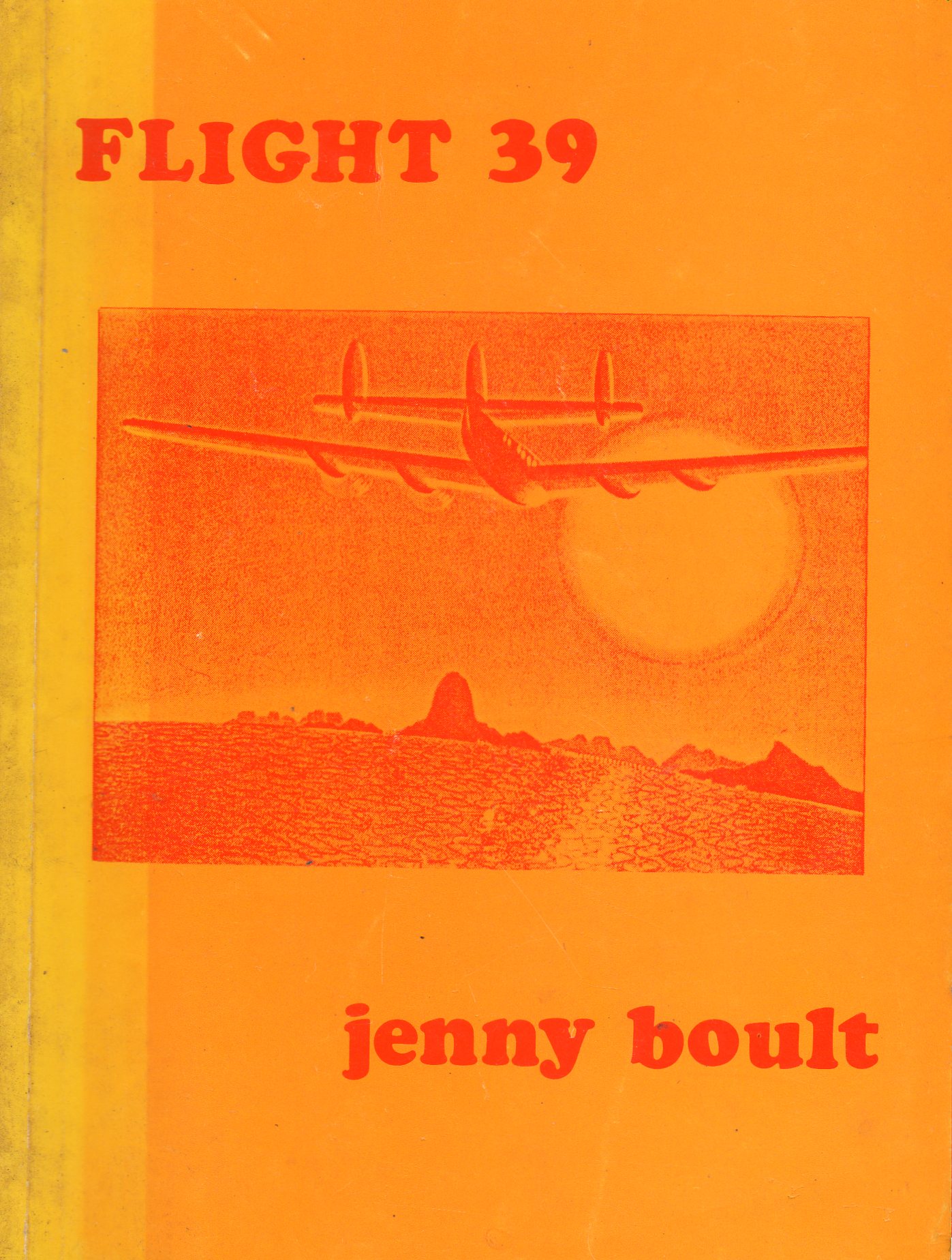
“i” is a versatile character WAV Publications, 1986. Flight 39, Abalone Press. 1986.. Both by Jenny Boult. Reviewed by Mark Roberts. First published in Tribune 23 July 1986.
Jenny Boult’s sixth book.”I” is a versatile character, is also her first book of prose. It follows her play, Can’t Help Dreaming, which was performed by the All Out Ensemble in Adelaide, and four books of poetry. The stories in this collection vary greatly in form and content, but they share a particular “poetic” style of writing which is rare among contemporary Australian prose writers. Although Boult is by no means the first Australian poet to publish fiction, she has been more successful than most in bringing to her prose many of the skills she has developed writing poetry.
The narrative structure of the stories also relies on a poetic model. Boult builds her stories around a series of images which eventually build into an extensive over-view encapsulating the whole story. The most successful example of this can be found in the title piece ‘”i is a versatile character”, and the impressive longer piece, “no room at the top”.
After this sense of freedom it comes as something of a shock to realise that many of the stories are. structurally, fairly disciplined. In “no room at the top”, for example, it is not until the final section that we realise that the piece has been loosely structured around the alphabet, “this is the last letter in the alphabet of pain, the final broken rung on the ladder, the damaged knee and the whiplash of intention.” It is not an easy alphabet, nor is it a heavy handed one. But it firmly anchors the story and allows the 26 sections to fall into place.
In “TWENTY QUESTIONS”. Boult uses a similar device, only this time the anchor is the title. We expect twenty questions, and. in a way, that is what we get. The only direct question, however, comes in the final section. In the preceding 19, the questions rise from the images, the pieces of the collage which Boult presents us with. We try to piece them together, looking for the answer as we go. But. Eventually, like Estragon and Vladimir Waiting for Godot, we are returned to the beginning: “The audience asks, “who is she?” The woman invites them to look again.
In contrast to the fantasy and experimentation in “I” is a versatile character. Boult has returned to her ‘roots’ as a performance poet in Flight 39. Boult has performed many of the poems in this collection to audiences around Australia over the last few years. Most of the poems are clearly meant to be read aloud, indeed, many of them sit somewhat uncomfortably as words printed on a page.
The song-like quality of much of Flight 39 gives the collection an accessibility which is rare among contemporary poets. Boult’s accessibility, however, is never patronising. Her appeal comes from her lyric style, the experiences she writes about and her wonderful black sense of humor.
There are poems about love (of course), housework, shopping trolleys, poetry and the British miners’ strike. In a series of “3 poems for mary kathleen”, Boult looks at nuclear war from a child’s point of view. One poem begins,
the cat’s going bald mum
the puppies are dead & dad’s called the vet for the old dog
there aren’t many birds.
This innocence disappears in the final poem when the child passes judgment on the post-holocaust society:
the grown ups are going to
patch things up &
pull the pieces together
but i don’t want to live
in a Frankenstein world.
But perhaps the strongest poems in this collection are the two poems grouped together under the title, “in solidarity with the british mine workers 1984-5”. In the first poem. “September 1984” Boult, who grew up in a British mining town, describes how she felt as she watched the attacks on the picket lines on television in Adelaide.
The second poem. “4th march 1985” is written on the day that the strike collapsed. One can sense the fury which is only just below the surface, but there is also the grief that this story will be repeated again and again:
I cried for the end of one struggle & the beginning
of the next.
You may have a little trouble getting these books from your local bookseller, but it is well worth the effort. You can also order the books directly from the publishers: WAV Publications. Box 545 Norwood South Australia 5067. and Abalone Press PO Box 2(12 Cheltenham Victoria 3192.
Published in Tribune – Summer Reading Issue (no 2406), 11 December 1985.
Mick Miller (right) and Dennis O’Rourke during the filming of ‘Couldn’t be Fairer’.
The Northern Territory’s recent campaign against the return of Ayers Rock to its traditional owners underlined the racism inherent in large sections of the white community in Australia. The “Ayers Rock for all Australians” (sic) campaign was not an isolated incident. Attacks on the basic human rights which Aboriginal people have gained through years of struggle are under attack across Australia, from both governments and corporate interests. But nowhere is it as vicious, or as overtly racist, as it is in Queensland and the Northern Territory.
Couldn’t Be Fairer, a new film by Australian filmmaker Dennis O’Rourke confronts the racism of the Queensland government and the white community of Northern Queensland. What emerges is a powerful statement, graphically illustrating the hypocrisy which seems to be the cornerstone of race relations in Queensland. O’Rourke has been internationally recognised as one of the most perceptive filmmakers on tensions between western and traditional culture. His films include Yumi Yet (1976) and Ileksen (1978) about the granting of independence and the first election held in Papua New Guinea. Yap … How Did You Know We’d Like It (1980) examined the effect of American television on the small Micronesian island of Yap. His most recent film, Half Life, which will be commercially released early in 1986, is a devastating account of the US nuclear weapons test program on the Marshall Islands. It concentrates on the effects exposure to highly radioactive fallout from the tests has had upon the inhabitants of the island.
O’Rourke was originally commissioned to make Couldn’t Be Fairer for the BBC program Third Eye, which is a series of programs designed to allow people from the third world to describe their conflicts with western culture. As O’Rourke told Tribune, “North Queensland, for Aboriginal people, could be regarded as the third world. What exists there is basically a colonial situation, both on and off the reserves”.
A major strength of the film is the power and commitment of its narrator, Aboriginal activist and chairperson of the North Queensland Lands Council, Mick Miller. The film follows Mick through Northern Queensland as he talks to his own people and discusses the effect that commercial development, such as mining and tourism, has had upon Aboriginal communities. We see how white Queenslanders effectively marginalise Aboriginal people, pushing them to the outskirts of white society. The alcoholism, sexual exploitation of Aboriginal women, and the degradation which is the result of two centuries of white oppression is in sharp contrast to the glimpses we are allowed of white Queenslanders in the film.
Joh Bjelke-Petersen, and members of the Queensland government, feature prominently in the film. In fact, the title comes from a statement from the Queensland premier regarding his government’s treatment of Aboriginal people. “Treat them the same as everyone else — couldn’t be fairer.” Mick Miller, time and time again, emphasises the hypocrisy and racism which underlies such a statement. Unfortunately, Couldn’t Be Fairer shows that Bjelke-Petersen’s racism is shared by many whites in Northern Queensland. Hotel workers, white drinkers, police, mining companies, even workers in the tourist industry show, by their statements and actions, that Aborigines are not treated the same as everyone else in the Sunshine State.
As Mick Miller says in the film, “We are living on the fringes of a white affluent society, treated as fourth and fifth class citizens …. We are truly strangers in our own land.” For Mick, Couldn’t be Fairer is an important and timely film, Speaking recently to Tribune, he said, “A film had to be made to show that in the little outback towns, nothing has really changed. Blacks are still being bashed and arrested for minor offences and it’s very difficult to lay charges against those responsible. “We wanted to show that, in Queensland, Blacks are still being treated the way they were 30 years ago, and that in some of the pubs in the little towns there are still separate bars for Blacks and whites. We Blacks still aren’t allowed to drink with the local ringers and land owners.”
It was an important film for Dennis O’Rourke as well. Although he had built up a reputation as a leading documentary filmmaker, until Couldn’t be Fairer he hadn’t actually made a major film in Australia. He had, however, been interested in making a film about racism in Queensland for some time. As he told Tribune, “growing up in a number of Queensland country towns, I was exposed to various forms of racism from an early age. “I didn’t understand it then, but there was obviously something different about the relationship between the Aboriginal kids and the white kids at my school. I remember feeling that it didn’t seem quite right. “Later, I decided that I wanted to make a film that was not so much about the ‘Aboriginal situation’, but rather one which attempted to pin down the nature of this sort of racism.”
Couldn’t be Fairer was filmed over a period of three months in late 1984. Dennis travelled around northern Queensland with Mick and members of the North Queensland Land Council, filming and interviewing people both on reserves and in towns. Later, when the film was being edited, Mick was often in Canberra in his various official capacities, so he was able to take an active part in the cutting of the film.
Problems arose, however, when the final version of the film was delivered to the BBC. It was decided that sections of the film were “too shocking” for English TV audiences. As a result, scenes dealing with drunkenness, the sexual oppression of Aboriginal women, and the degradation which many Aborigines had been forced into, were cut from the version which went to air in England. In all about half the film was edited out without the permission of Dennis or Mick.
Although Dennis told Tribune that there wasn’t anything which he actually found objectionable in the BBC version, he believes that the film lost some of its impact and many of the major issues had been subtly avoided. Mick believes that the BBC decision to cut the film reflects the naivety of the British. ‘They simply couldn’t believe that a state in Australia could have laws, or could subject its Black people the way Queensland does.” Mick saw the BBC decision as symptomatic of the attitude of many whites when confronted with the facts about racism — they simply don’t believe it exists or that it is as bad is you make out. “They say ‘We’re not all racist’, but lots of them still scream and oppose the little bit of help the Aboriginal people do get.”
Couldn’t be Fairer illustrates powerfully that the gains made by Aboriginal people in Australia are the result of years of struggle against deeply ingrained racist attitudes. As Mick told Tribune, ‘The system is designed to pull us down and keep us in the muck, but we fought it. That’s how we got to where we are today. Nothing would have changed through the goodwill of the government.”
THE POEM AS HISTORY The Ash Range by Laurie Duggan (Picador, 1987), 270pp. Published in The Phoenix Review No3. 1988.
My first introduction to Laurie Duggan’s work occurred during my final year of high school in 1977 when I read a poem called ‘Marijuana Christmas’ in an issue of New Poetry which I found in the local library. Duggan’s broken verse narrative was one of the few poems I came across during my final two years of schooling which suggested that there might be more to poetry than the generally insignificant British poets which were still being force fed to my generation in the class room.
Looking back eleven years later it is interesting to note the sense of continuity from Duggan’s early work to his recent book length poem/history The Ash Range. In ‘Marijuana Christmas’, for example, Duggan is already effortlessly combing basic scientific observation with vivid poetic images:
igneous and metamorphic rock
overlaid by sedimentaries
granite, shale, chalk
quartz on the bottom of the pool
like an Italian ice cream
light veins with white across
In fact many of Duggan’s poems are essentially poetic collages — images, descriptions, historical records and snippets of conversation become essential parts of the poem, cemented together by Duggan’s own, often wonderful, verse.
Another poem worth taking a look at in terms of Duggan’s poetic development is ‘Crawling From the Wreckage’ from his 1985 collection The Great Divide. In this poem Duggan has pulled together isolated quotations from sources as diverse as ABC broadcasts of parliament, Jack Lindsay’s The Roaring Twenties, Nelson Eddy and historical accounts of Black Thursday. While the result is a sometimes jarring, lurching poem which promises much more than it actually delivers, it is, in many ways, a direct predecessor to The Ash Range and shows that Duggan has been experimenting for some time with the structures he has eventually used in his book poem.
A major feature of The Ash Range is its concentration on place and history. It is a poem about the area of Eastern Victoria known as Gippsland. Duggan has always been an excellent nature poet. He has the ability to ‘draw in’ pieces of the landscape he is writing about so that the poem becomes a collage of words, rocks and trees. In The Ash Range he has gone a step further. Here the landscape becomes part of a far greater picture, is interwoven with the history (both pre and post European) of Gippsland. In fact, one of the poem’s greatest achievements is the way in which Duggan has linked the sometimes subtle changes in the landscape with the movement of history.
As in ‘Crawling from the Wreckage’ Duggan makes extensive use of original source material in The Ash Range. In a note at the end of the poem Duggan refers to The Ash Range as a ‘poem including history’, adding that it has many sources and that overall it should be read as the product of a ‘shared consciousness.’ Duggan’s role in the creation of The Ash Range at times appears to be almost that of an editor rather than poet. Once again in his notes he tells us ‘I have not hesitated to meddle with texts: editing them down, altering the grammer, restructuring sentences in the interests of clarity’; Indeed, throughout the book it is possible to see Duggan’s touch on almost every piece of source material so that while it may be possible to say that The Ash Range has many sources, overall it is, very definitely, Duggan’s own achievement. If, however, it is possible to voice one criticism about the structure of the poem, it is that it has not allowed Duggan to use more of his own very fine poetry.
Duggan’s account of the history of Gippsland is often at odds with the official version. Throughout The Ash Range he tends to concentrate on the tragic and the everyday. His account, for example, of the first contact between Europeans and the Aboriginal people of Gippsland, which while not by any means unique, is still, none the less, extremely moving and tragic:
On one of the arms of the Lake
there were a few blacks,
and one of the old men
proposed to take mullet to the white-fellows,
started, accompanied by a little boy.
Within sight of the hut the boy
noticed the white man signalling them off.
The old man took no notice.
The boy heard a gun fire:
saw the old man fall.
He dropped his fish
and ran to tell the tribe.
The history also includes an account of the rapid annihilation of the Aboriginal people of Gippsland by the European ‘settlers’. In the first years of white settlement Duggan can write of ‘500 to 700 Aborigines/assembled for feasting’. But by 1864 the Reverend Hagenauer could only assemble 130 at his mission station at Boney Point, Lake Wellington. The sections of The Ash Range dealing with Aboriginal/white contact puts the more recent history of Gippsland into context. The attitude of Aboriginal people towards this history is summed up by a quote from Philip Pepper at the beginning of the section ‘White Palings’: The bad times really started when that fella Batman came to Melbourne’.
Throughout that greater part of The Ash Range which deals with the purely European history of Gippsland, Duggan is concerned with the insignificant and the ordinary. We hear, for example, of how Robert Robertson, ‘a well known Bairnsdale painter, and George Johnston, ‘a carpenter’, were arrested in 1916 for ‘illegally killing fish’ with a tomato sauce bottle loaded with gelignite.
Duggan devotes a whole section to the rise and fall of a small gold mining town called Stirling. The town was founded shortly after 1882 and effectively ceased to exist around 1920 after the Post Office was closed and the hall moved to another town. The high point for Stirling would appear to have been in July 1899 with the Stirling Ladies invitation dance:
songs sung at interval
by Mrs Butcher. Mrs Tait;
and some of the gentlemen
studying ‘federation’.
But the rapid decline of Stirling after the gold ran out was not an isolated event
So, Glen Wills:
a sign in a clearing:
at Sunnyside there’s nothing:
Grant a graveyard
if you can find it.
And Stirling?
The base of a chimney,
overgrown,
in a small clearing;
dark water,
a wild fruit tree.
Given the impressive achievement of The Ash Range it is difficult to see why it has failed to pick up any of the major awards. Although its publication comes at a time when there is, perhaps, an unprecedented number of book length Australian poems or poetic sequences in the book shops, Duggan’s achievement in The Ash Range is at least equal to that of Alan Wearne in The Nightmarkets. Both these works are impressive reminders of the current maturity of Australian poetry and both have broken out of the ghetto to be read by people who generally would not read poetry. While The Nightmarkets literally exploded onto the literary stage in a blaze of publicity (and sales), it is tempting to suggest that The Ash Range’s reputation (and sales figures) will steadily grow over time. One thing, however, is certain: in The Ash Range Laurie Duggan has written what is destined to become one of the major Australian poems of the eighties.
Over a number of years now Susan Hampton’s reputation as a poet of a consistently high standard has been steadily increasing, largely as a result of the considerable body of her work which has appeared in various literary magazines and journals. It comes as a surprise, then, to realise that Costumes, her first complete volume, has been greeted with almost two years of critical neglect.
If we turn to the book itself in an attempt to find reasons for this neglect, we quickly find ourselves disappointed for Costumes is, in many ways, a virtuoso debut, as Hampton shows herself to be in control of many different styles and techniques. One has only to compare the surrealist prose piece ‘Catalogue of Five Words at an Exhibition’ with the apparent autobiographical detail of ‘In the Kitchens’, to be aware of the range and scope of her work.
Throughout the volume, Hampton is always conscious of being a poet, both in the way she observes what is happening around her, and how she relates it to her own emotions. We become aware of the importance she attaches to individual words in a ‘Catalogue of Five Words at an Exhibition’; here Hampton describes a method of memorising single words which she has taken into the country:
We begin at the Angel Islington in a pub, looking at ourselves in the mirror. As we looked, she told me the first word. We walked from then pub to a phone-box, to the supermarket then to the tube station, the flowerseller with his red blooms, past a hoarding, then along Upper Street to the doorknocker on her house. At each of these stops she gave me a new word, and I was to recall them by walking this journey until I could do it in my mind, associating each word with an object on the way. It proved successful, and I wondered whether this was how Mandelstam’s wife memorised his poems to bring them out.
Words are obviously important here, and a close relationship exists between the individual words and the associated objects. It is no co-incidence that ‘Catalogue of Five Words at an Exhibition’ opens Costumes, for through it we are introduced to the poetry that will follow. The idea of a “Museum of Words” recalls the various museums in Murry Bail’s Homesickness, but Hampton sees little point in museums themselves:
The Museum of Words. I think this is a bad idea. Leave
these in the gallery for a while, and then give them
to people walking by.
The poems that follow are definitely not intended to hang in a gallery. Although our first reaction may be that Costumes consists of a number of very good, but also very different poems, as we progress further we become aware of a number of subtle but important ways in which poems of opposing techniques and styles are, in fact, related to each other. This can perhaps be best seen if we look at the way a number of Hampton’s best poems grow directly from everyday incidents. Early in the title poem ‘Costumes’, for example, we read:
Waiting for a bus, I rock gently on the edge
of the footpath, all manner of people coming past me
the ones in green dresses the ones with very short hair
In ‘Costumes’, and other poems such as ‘Jubilate Sydney’, ‘Ode to the Car Radio’ and ‘Waiting for Rain’, we see emerging a particular way of looking at the city, and, more importantly, the poet’s relationship to that city. The concluding lines of ‘Jubilate Sydney’ reflects one manifestation of that relationship:
For tenthly there’s a cloud accompanying me
my windscreen is better than the latest Italian movie
The same sentiment appears in ‘Waiting for rain’:
& yes, life’s an Australian movie just now, no plot
but some very taking shots
Although part of the attraction of these poems lies in the way the actual incidents are described, their real strength is Hampton’s ability to suggest an inter-relationship between many apparently trival observations. In a comparatively simple poem, such as ‘Waiting for rain’, this is achieved by the way the richness of the first section, where the poet is riding a bike across the campus of Sydney University, is contrasted with the sterile second section, when she has arrived at work. The poem works towards its final statement in the same way that a skillful scientist might support her/his theory, for when the poem concludes:
I want to go out into the rain.
there seems to be no other possible conclusion.
‘Costumes’ can be seen as an extension of ‘Waiting for Rain’. It is a far more ambitious poem, and structurally more complex, but again it relies upon the poet’s observation of her surroundings. This time, however, she is still and watches the city move around her. Her passiveness, though, is only physical, for the way people “narcissistically half-watch” themselves in the numerous mirrors of the MLC Centre becomes a metaphor for the shallow nature of the glamorous image they seek to buy:
And the mirors say, you have bought something from us,
look at us and see how you shine as you move, buy more
look more, shine more, buy yourself from us we have
a big range of styles.
The poem becomes increasingly ironical so that when the people leave the mirrors and walk into the street past
cripples with badges
fat girls from out of town, warehouse clerks with sore legs
and white noses, past all the losers.
the glamour and shine has all disappeared.
The five poems grouped together in ‘In the Kitchen’ also appear to be largely autobiographical, describing the poet’s childhood in Inverall and Newcastle. There is a gentle feeling of progression about the sequence. Each poem seems immediate and important, perhaps because with the exception of ‘Invererell’, they are all written in the present tense. They reflect a child’s growth, from early memories of an insurance sales and amateur magician, to bars in Newcastle and writing poetry imitating Eliot. The sequence appears almost crafted, for while it has at its centre, the memories of different kitchens, each poem expresses a mood unique to a particular period of growing up.
On e feature, then which runs through an unites Costumes is the way in which the majority of the poems have, as their centre, the poet herself. The best poems in the collection, however, use this as a starting point to make statements which transcend the personal. This is true not only of those poems which deal with the external world, but also those which concentrate on the personal or physical subjects. ‘It’, for example, begins by describing the feelings, both physical and emotional, associated with menstruation:
It grabs from behind &
whomp! you’ve gone mad again tonight, despite Vitamin B
& the gynaecologist’s plan for sanity.
As the description continues, the poet’s anger grows until, in the final lines, it overflows into violence:
Now the world’s
a different place, malign for sure, & we’re crying
(big girls do) about nothing, we know its nothing,
but we really want to kick the shit out of something
tonight, we’re violent, & we’re tired of making
little parcels & putting them in the cupboard.
In the final instance Costumes is true to the criteria that Hampton herself stated at the beginning of the collection in ‘Catalogue of Five Words at an Exhibition’. The majority of the poems refuse to be “hung” for an length of time on the gallery wall. Rather we find ourselves recalling the way we have felt in a particular situation,or perhaps see elements of ourselves in the poetry, so that seemingly personal statements suddenly take on a much wider significance. Costumes confirms Hampton’s standing as a poet of exceptional ability, and establishes he position as one of the best writers to emerge over the last few years. The fact that this collection has passed almost unnoticed by the majority of critics (there have been a few exceptions) is a sad comment on the quality of contemporary criticism.
(As these books are out of print I have provide links back to the Australia Poetry Library were the books reviewed are now online).
In the closing scene of Alfred Hitchcock’s North by Northwest, Cary Grant and Eva Marie Saint are battling the forces of evil on top of the Mount Rushmore monument. Saint falls and Grant scrambles down to save her. He is holding her with one hand while the other hand grips the cliff top. Just as the bad guy is about to crush Grant’s fingers under his boot, a shot rings out the bad guy falls dead. The camera then zooms onto Grant’s arm as he strains to pull Saint to safety. As the camera tracks back the scene has suddenly changed to the interior of a railway sleeping car. Rather than pulling Saint to safety, Grant is helping her up to the top bunk. Suddenly the scene changes again and we see the last shot of the film which shows an express train plunging into a tunnel.
Such symbolism, while very obvious and heavy handed, works because Hitchcock had his tongue very firmly in his check. In Craig Powell’s poetry very similar symbolism appears again and again, but there is no undercurrent of humour to relieve the ever thickening emotions. In fact the very image of a train plunging into a tunnel appears in one of the newer poems in Minga Street: New and Selected Poems, a volume which combines a number of new poems with a selection from his previous four collections of poetry:
miners or fetlers
With calcium grins and sooty jowls
A child knows they are cheering for him
Coalcliff now the deepest tunnel starts
And, just in case the symbolism of the tunnel escapes you, the poem concludes
And a cello sings in his throat
Of the shadow immense womb of rock
Where he sleeps with his eyes white and wide
‘In the Presence of Paul Tortielier’
Powell’s professional background as a psychoanalyst has obviously been one of the major influences on his writing. In ‘Visitors’, another recent poem, he writes of the fragile nature of a family’s perceived history:
whose mother’s lover fumbled at her at nine?
She is easily wiped out you being her only
witness and I don’t always want to hear you
And your mother’s friend plucks another scone and simpers
‘You must be very proud of your mother’
You smile you ask politely ‘How long have you known her?’
‘Visitors’
Throughout his work Powell continually attempts to break through the mental barriers to explore what David Brooks has called ‘the psychic depths’. Unfortunately, far too often, these depths are populated by the overused imagery of Freudian psychology. This is not to say that Powell has not written some very fine poetry. Rereading some of the Canadian poems which were written during the mid to late seventies, I was impressed by the intense lyricism of the best of Powell’s poetry. In ‘Canada Geese’, for example, Powell uses the image of geese flying south to suggest absence and renewal:
Some evening when we are
Unaware they will beat southward
invisible by the windy
stars and frost will affect
our teeth
‘Canada Geese’
As a record of Powell’s work over the last twenty-five years Minga Street is, in the final instance, a frustrating collection. I was continually drawn towards Powell’s gentle lyricism which creates some memorable images. At the same time I found it difficult to accept the overuse of psychoanalytic imagery where, for example, old mens bodies “glimmer with the sperm/of sorrows” (‘Spoken to Women’), and where
the pure horses half-sleeping rise
from the earth so high
and so quiet their eyes gentle
upon us searching towards
a distance emptied of images
where they sway our seed in their thighs
‘in Spruce Woods’
or where trees are:
like women
sheathed in bark to their navels but
their eyes and breasts fervent and lovely
‘Lessons at Collaroy Plateau’
Gary Catalano’s Selected Poems 1972-1992, like Powell’s collection, also contains some previously uncollected poems. But while Powell delights in a poetry dense with imagery, Catalano, for the most part, is a far more subtle poet. At times, particularly in his early work, the simplicity of his imagery suggest the influence of haiku, Poems such as ‘Tree’, ‘The Blizzard’, ‘Against the Thunder’ and ‘The Exploration of a Continent’ from the 1973 collection ‘Remembering the Rural Life’, are short, simple poems whose impact is much greater than one would expect at first glance:
A horse
Shaking the dust
From his coat
flies
Noon heat.
In the clear
blue sky
no cloud to
expunge our defeat.
‘The Exploration of a Continent’
Complementing these short poems in the selection from his from his earliest work is a long poem ‘Remembering the Rural Life’. In this impressive poem Catalano recreates the landscape of his youth, a landscape lost to him both by time and the spread of suburbia. In the Parramatta of the late fifties and early sixties Catalano draws together the threads of his background – his family’s Italian heritage, his adolescent bravado and the growing conflict between a father’s vision of his son’s future and the son’s interest in art and poetry. The strength of the this poem is that it avoids slipping into sentimentality; instead Catalano has utilised an economy of image which is apparent in his shorter poems to create a narrative about memory and growth which effectively sets the tone for much of the other work in the collection.
Catalano is one of the few Australian poets to work extensively with the prose poem. Selected Poems brings together a handful of prose poems from Heaven of Rags (1982) (http://www.poetrylibrary.edu.au/poems-book/heaven-of-rags-0359000) and a selection from his book of prose poems Fresh Linen (1988) (http://www.poetrylibrary.edu.au/poems-book/fresh-linen-0360000). Catalano’s style is ideally suited to the prose poem as he is easily able to avoid the poetry being subsumed by the structure of the prose. In one of his best prose poems ‘At the Source’, Catalano uses water flowing from the source of a creek to the ocean as a metaphor for speech:
It is here that we find our clearest
image of speech. They taste so clean,
these syllables of the dark, and they
make us realise that all our words
should be pitched at a whisper.
But, once speech, “these shy waters’ flow into the ocean, their nature changes:
Here it bends
itself on the ear like a sheet of fresh,
unscored linen…and here it offers an
escape from the inchoate music of
the world.
‘At the Source’
There are also a number of prose poems among his new work including the very brief poem ‘Silver and Gold’ which once again highlights the beautiful simplicity which Catalano can achieve at his best:
The waves look like silver-foil. But
when they break on the shore, I hear
the sound of a hand sifting through a
bag of grain.
‘Silver and Gold’
While Jill Jones has not yet reached that point in her career which would justify the publication of a volume of selected poems, at her current rate of production she could very soon reach the milestone which Powell and Catalano have just achieved. In fact, the success of her first book, The Mask and the Jagged Star (1992) http://www.poetrylibrary.edu.au/poems-book/the-mask-and-the-jagged-star-0062000 has ensured that her second collection, Flagging Down Time, will attract more than its share of critical attention.
As the title would suggest, Jones’ book is concerned with the concepts of time and change. For Jones, time represents the potential for both growth and decay, and among the images that recur throughout the book is that of the garden. Grass seeds in the desert, for example, lie dormant until rain falls:
She’s like plants at ground level
surviving as seeds through dry periods –
tough outside while inside
she’ll grow the grasslands of dreams.
This poem concludes with one of the most striking images in the book:
that road where past and future meet
only at the horizon
and there’s all that walking between
‘The Desert’
The idea of time running from the past through the present to the future is reflected in the title poem where time is a taxi that can be flagged down:
the meter is silent now
but just as inexorable
as the ticking of my plastic watch
‘Flagging Down Time’
Flagging Down Time concludes with the impressive longer poem ‘Eleven fifteen’. While time can be a road which runs from horizon to horizon, one has to remember that the horizon also runs in an arc which joins the two ends of the road. This sense of the cyclic nature of time is picked up in ‘Eleven Fifteen’ where the final line of each stanza becomes the first line of the next. Such a structure reflects the repeated rituals which seem to merge days together while, in fact, weeks, months and years may pass:
……fantasies
which take on a stranger syntax as I travel
through the midnight hour that has always stood
like a dark faery nought, round zero of change
‘Eleven fifteen’
Flagging Down Time should confirm Jones’ reputation as a major new voice in Australian poetry. It will be interesting to see how much longer we have to wait for her third collection.
Martin Harrison’s poetry can appear difficult to come to terms with on a first reading. It is a dense poetry with rich images overlapping and merging, driven by an often sensuous use of language which at times seems almost ready to rebel being restricted to the page. Indeed, to appreciate Harrison’s work, the reader must realise that often the sound of the language is as important as the meaning of the word.
As well as being a poet, Harrison has a background in sound/text performance and is a teacher of sound composition. While his poetry may not be performance pieces in the way Amanda Stewart’s work is, the influence of sound and film in his work is obvious. At times, for example, Harrison’s descriptions are so intense they are almost filmic:
You want it all to come back –
April’s sharper lights,
Light-grids, networks, windows off
A shady green
‘Beauty Line’
But it is a film with a distinctive sound track. The best poems in this book seem to invoke an image which is aural as well as visual. In ‘Meeting’, a poem within the long sequence of poems called ‘Films’, Harrison captures the sound of the wind rustling through the grass:
Wind jiggles the shell-grass
Making itself visible
Like someone brushing a mobile
‘4. Meeting (from Films)’
In another poem, ‘Marriage and Soundscape’, Harrison takes great care in describing a sound:
Then a shag took off from these waters, making an interval, a year,
My wife has just seen it – calling it ‘hair on a lens’ and ‘shadow noise’.
(There is green, there is a clapping-Sound, there is wind.)
‘Marriage and Soundscape’
Harrison’s imagery often flows together in the same way that a sound can gradually be transformed into a completely different sound without a casual listener being aware of the change. In ‘Then and Now’, for example, a description of the wind blowing leaves in a tree becomes, within the space of four lines, a lion and the entire poem moves off in a completely different direction:
Late wind arrives, shakes the leaves
in a porridge of shimmers, like a mane-
A lion gets up, wlks about
Caged. foetid, in a fitful mind
‘7. Then and Now (from Films)’
Mark Roberts 1993
(Note: the layout of the quoted in poems in this review in Scarp was a little problematic. We possible I have gone back to originals poems to try and ensure the layout is correct in this version. From memory I also beliee there was a final paragraph to this review. But as I no longer have the original copy I have left the last section as it appeared in SCARP)
Review of Bliss, By Peter Carey, University of Queensland Press, 1981. Going Down Swinging Issue 5 Spring 1982.
Peter Carey’s first novel, Bliss, must have been one of the most eagerly awaited books of last year. Its publication was preceded bu profiles of Carey in both The Age and The Sydney Morning Herald, both of which later gave the book good reviews. But even before the literary establishment began its fanfare I was suspicious of Carey’s novel. I have never been able to fully reconcile his role in advertising with his reputation as one of Australia’s leading younger writers. Despite this I enjoyed his first two books of short stories, though at times I doubted his motives. As a result I approached Bliss in a critical frame of mind. It lasted twenty pages. Once again Carey won me over in spite of myself.
The novel is basically the story of Harry Joy who, like Carey, is in is late thirties and involved in the running of a moderately successful advertising company. Harry, however, suffers a heart attack and lies in his backyard, clinically dead for nine minutes. During his ‘first death’ he discovers:
“That there were many worlds, layer upon layer, as thin as filo pastry.”
For a time he is completely at peace, but the possibility that a corresponding world of terror may exist sends him fleeing back to his body as it is being carried out the front gate. The rest of the novel is concerned, min the main, with Harry’s response to his new found insights into the evil and hypocrisy which everyone else takes for granted. To add to his confusion Harry actually believes that he has died and the new world which he is discovering is, in reality, hell.
Bliss adopts a far more rigid moral and political stance than any of the earlier stories. Of course Carey’s work has always been political in a sense, one only has to look at the title stories from The fat man in History and War Crimes for evidence of this. What I am suggesting, however, is that in Bliss Carey is being more directly political than before, and, particularly in his portrayal of the advertising industry, manages to make quite strong moral judgments.
One of Harry’s most disturbing discoveries in Hell is the fact that many of the products he has been involved in advertising are strongly carcinogenic. Worse still, he realizes that he was perhaps the only person who wasn’t aware of it. Carey also hints at a cancer epidemic which, we are told, will sweep through the West and most of the industrialised East within a few years.
It is interesting, while still on the political aspects of Bliss, to look at a comment Carey made in an interview with Kate Ahearne, Stephen Williams and Kevin Brophy (Going Down Swinging No. 1 1980). When questioned about Craig Munro’s doubts about his role in advertising, Carey answered that it had given him a chance to work with other people, and also that it had given him a solid political education. It is possible to apply this statement to Harry Joy, though perhaps his ‘political education’ is a little sudden. For most of the novel Harry has to struggle with his political consciousness, his desire to produce a ‘good ad’. The conflict is only finally resolved when Bettina, his wife, finally gets the chance to fulfill a lifelong ambition of designing and producing her own ads. She is blind to everything but the beauty of her ads and her desire to break into the big New York ad houses. Her dreams though, are shattered by her discovery that she is suffering from incurable cancer, probably as a result of long term exposure to petrol vapours. Bettina turns against the petrol company for which she has been designing ads, destroying both herself, and the entire Board of the company with a petrol bomb.
Despite the ‘political realism’ of Bliss it is, in the final instance, far more optimistic than most of the stories. Carey himself admits (GDS, No1, 1980, p.46) that his early stories are, essentially, fatalistic. In the second collection, War Crimes, stories such as “He Found Her in Summer”, and “The Puzzling Nature of Blue”, are at least moving towards a position where the possibility of optimism is admitted. Bliss, however, concludes on a note of ecstasy. Carey refers to the unqualified happy ending to Bliss in the interview by commenting on Harry’s development from total innocence to a point where he confronts “the shit out of the world and comes to some real positive conclusions about it.” I agree with Carey when he says that this represents a big development (movement is probably a better word) on his earlier work.
Bliss, both in its language and content, is a very crafted novel. Although primarily the story of Harry Joy, all the other major characters dominate sections of the novel. This I had a feeling that hidden within the novel were a number of individual stories, cut up and distributed carefully throughout the book. Or perhaps this is coincidental, a result of the method of narration that Carey has employed. We learn, in the last lines, that the narrator’s voice in fact belongs to Harry and Honey’s children, who have obviously grown in a up in a tradition of storytelling, a profession that Harry adopted after his arrival at Bog Onion Road. So finally the novel turns a complete circle. Harry finds that the Bliss that was suggested in his ‘first’ death finally in his third death, after he has returned to the childhood memories of a guru-like father. The ending maybe, as some critics have noted, simplistic and contrived; nevertheless it still managed to move me on the two occasions I read it.
Of the many diverse influences on the novel, perhaps the most surprising, as far as I was concerned, was the apparent debt Carey owed to Tom Robbins of Another Roadside Attraction and Even Cowgirls Get the Blues fame. The major areas where this becomes obvious is in the method and style of narration and the character of Honey Barbara. In both of Robbins’ early books one of the minor characters later identifies himself as the narrator, explaining both the insights and the asides which characterize the narrative style. In Bliss, the revelation of Harry and Harry’s children as narrators can perhaps help to explain a similarity between Carey’s and Robbins’ narrative voice. The character of Honey Barbara also appears to owe much to Robbins. The similarity between Honey and many of Robbins’ female characters is particularly noticeable in small details such as the way she walks and her often impulsive, but enlightened dialogue. This became for me the weakest aspect of the novel, perhaps because the flaw was so unexpected and because Honey Barbara is the bridge between the cancerous city world and peace of the alternative life-style at Bog Onion Road. This Honey, who eventually becomes the most important character after Harry Joy, becomes, at times, almost contrived, and disrupts the smoothness which characterizes the rest of the novel.
The publication of Bliss came at a time when Carey’s earlier stories were being published overseas in a variety of different forms. It remains to be seen how many readers in America and England will react to the Carey novel. For me, despite a few flaws, the hype that surrounded its publication and my own doubts about Carey’s 9decreasing) role in advertising, Bliss was one of the more impressive novels I read during 1981.
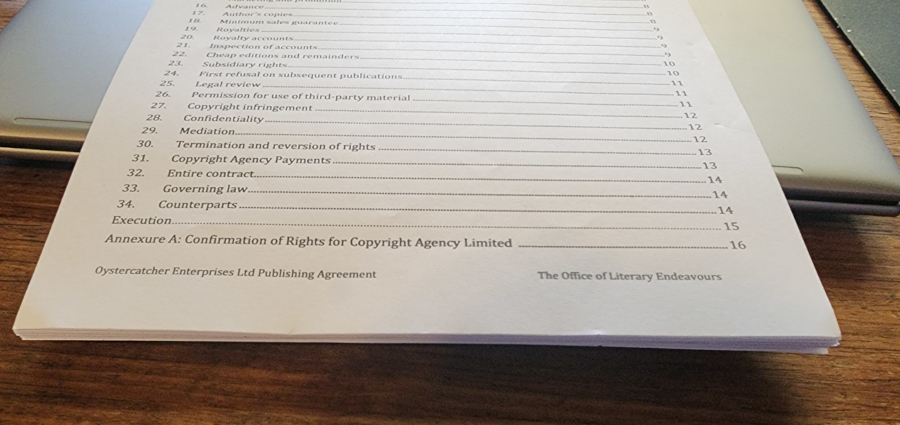




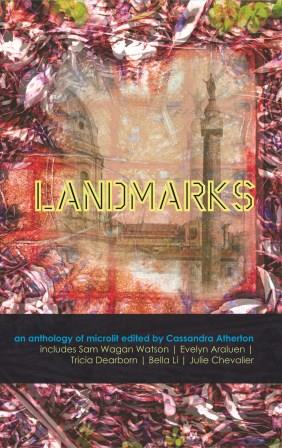




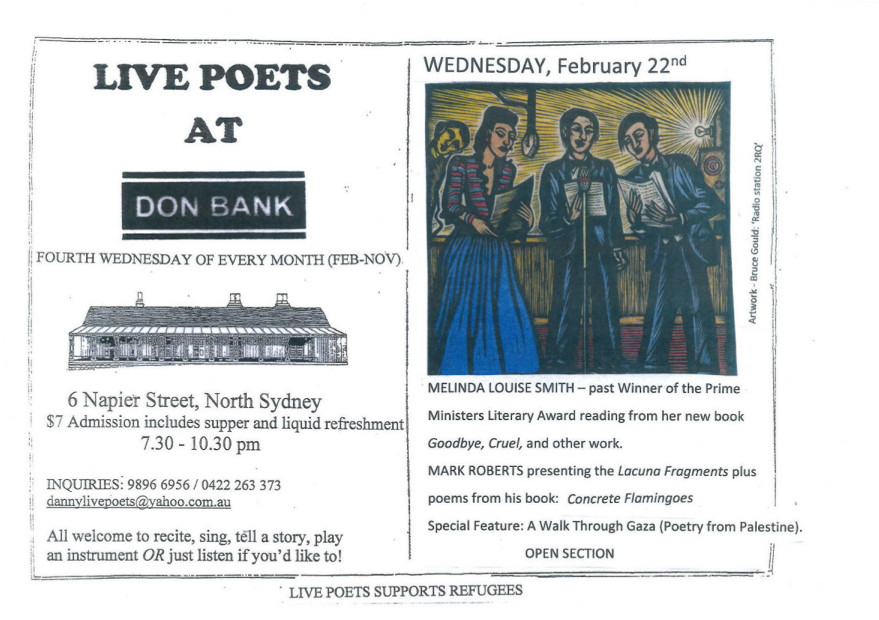
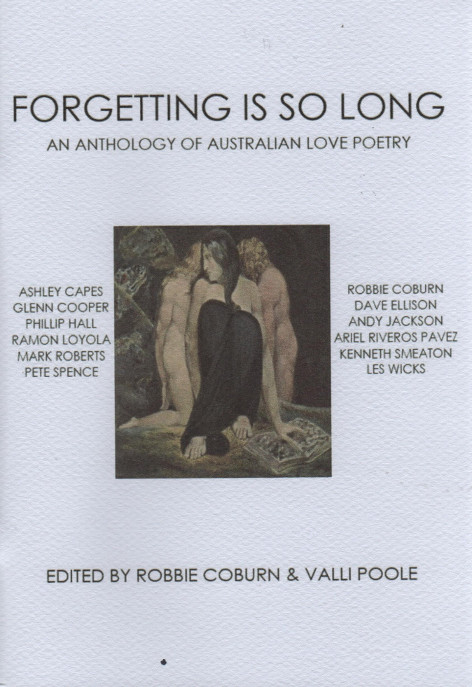

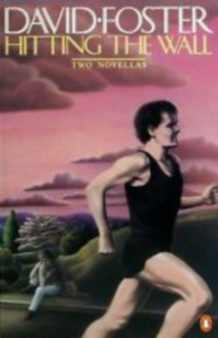
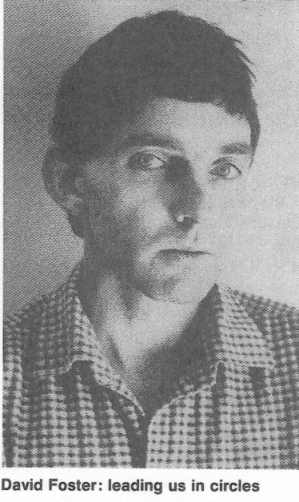
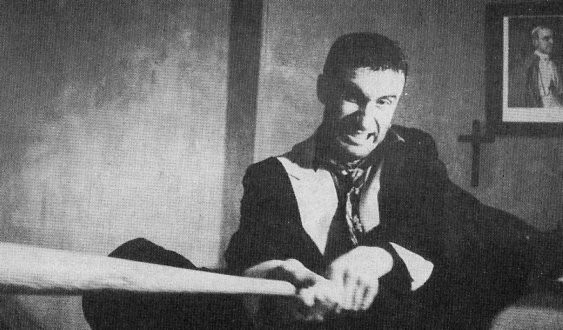

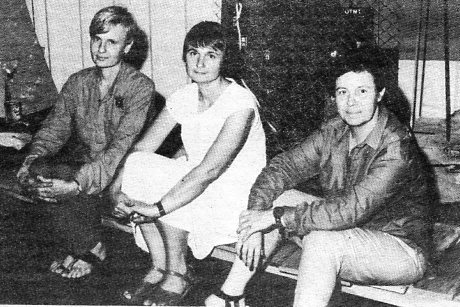


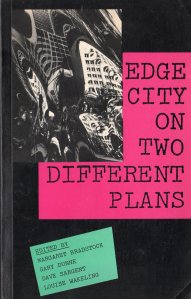 In a recent interview (Image Vol.6 No.3), John Tranter talks of the progression of contemporary Australian poetry in terms of a “pendulum swing reaction” against what is seen as the ‘accepted’ or ‘established’ mode of expression. Such a comment, of course, refers back to the “generation of ’68” and the break that many writers felt they were making from the established, conservative forms of writing which had predominated during the fifties and sixties, but it also implies a conservative backlash which, Tranter suggests, will “swing” the writing scene back to something resembling the pre-’68 situation. On a similar note, Kris Hemensley, reviewing Ania Walwicz, Dimitris Tsaloumas and Mary Fallon (Syllable No.1), talks of the “rut” in which contemporary Australian writing “had become stuck” by the beginning of the eighties. One possible explanation for this is that the writers who saw themselves as the poetic revolutionaries of 1968 now feel quite comfortable with the way Australian writing has developed during the seventies and no longer feel it necessary to question or challenge the prevailing mood of the literary establishment.
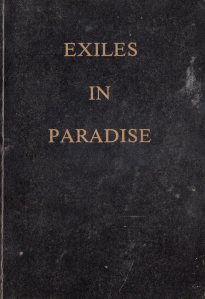 Paradise lacks a unifying theme and is without Edge City’s encompassing introduction. Network/ Exiles in Paradise is, in fact, two different anthologies, separated not by theme, but in the way each was produced. We are told simply “the editing, compilation and lay out of ‘Exiles in Paradise’ was performed by the writers themselves;. ‘Network’ drew on writers within the book and Fringe Network for its production.” So Network/Exiles in Paradise has taken the idea of an open access anthology a step further to collective production. One of the stated aims of the anthology is to “encourage writers to be responsible for their work beyond its actual creation.”