Poetic Journal: 17 December 2017 ‘hidden’

19 Dec

Over the coming few weeks I will be doing a bit of travelling on the other side of the world. I have decided to try and keep a small poetic journal to capture some of my observations and thoughts during this period. The poems aren’t complete or polished, please treat them more as observations or first drafts. The first post is dated 17 December and covers the flight from Australia to Ireland.


hidden

leaving melbourne
flying northwest
across night desert
below
…………darkness scattered lights
above
…………a richness of stars
stories are hidden here
even in daylight
but at night they call to us
singing across country
and reaching into the sky

…………in this plane
we eat
watch a movie
and try to sleep

.

.

Poetic Journal: 18 December 2017 ‘Yellow Sea Chest’


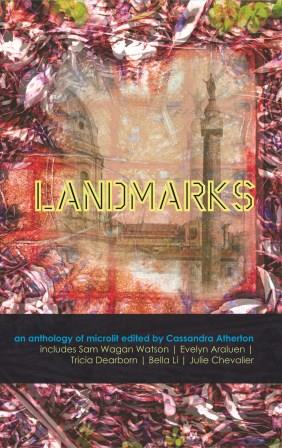
‘Yaranigh’s Grave’ appears in ‘Landmarks: Microfiction and Prose Poems’ edited by Cassandra Atheron

28 Nov

I haven’t sent much work out over the last 12 months but I have been fortunate to have a number of pieces appear in various magazines and anthologies. Many of these have been from the Lacuna manuscript which I am still working on 18 months after I originally thought it was completed. One of the pieces in Lacuna is a poem inspired by a visit to Yaranigh’s grave just outside of Molong NSW.

Yaranigh was a Wiradjuri man caught up in the rapid dispossession of Aboriginal lands in the first half of the 19th century.  Yaranigh straddled both Aboriginal and European cultures and worked on expeditions with with early colonial ‘explorers’ through NSW and Queensland, acting as a guide and interpreter as the expedition moved through different Aboriginal nations. The most famous of these expeditions was with Sir Thomas Mitchell’s expedition to find the mythical inland sea. On  his death Major Mitchell gave him a formal European burial while his own people surrounded the graves with ceremonial carved trees. This combined tribute made me think of delicate situation Yaranigh must have found himself in and how he might have attempted to limit the impact of the Europeans by carefully negotiating passage away from scared sites and areas of importance to local people.

Landmarks is described as an anthology which tackles the theme of Landmarks: critical or celebratory, watershed moments or turning points in history, culture or in relationships. It seemed to me that my poem about Yaranigh’s grave was a good fit for such an anthology. Unfortunately the anthology was looking for microlit and ‘Yaranigh’s Grave’ was a poem. So, not for the first time, I attempted to take a work in one genre and rework it into another. The version that appears in Landmarks is therefore a different work than the one that exists in the Lacuna manuscript. While I still think the poem is a more powerful piece I am still extremely proud that the micro prose version of ‘Yaranigh’s Grave’ has appeared in Landmarks.


Landmarks: Microfiction and Prose Poems Edited by Cassandra Atherton. Spineless Wonders is available from https://shortaustralianstories.com.au/product/landmarks/

‘The Office of Literary Endeavours: Maree’ appears in Postcolonial Text Vol 12, No1 (2017)

11 Jul

Theresa Hak Kyung Cha’s Dictee; Dictee Takes the Stage. Photograph by Soomi Kim. The cover of Postcolonial Text Issue 12: No.1

I am very pleased to have had ‘The Office of Literary Endeavours: Maree’ published in the on-line journal Postcolonial Text. This poem is an interesting one for me as it grew out of a novel I’m attempting to write. As part of my research I was reading a lot of poetry in translation. I found myself increasingly wanting to get ‘behind’ the translation to the poem – to read different translations of the same poem and to use online translation tools and dictionaries to create my own literal translations.

One of the poets who caught my attention during this time was the Spanish poet Luis Cernuda. Cernuda was born in Seville in 1902 and during the Spanish Civil War he found himself forced into exile when he was unable to return from giving a series of lectures in England. Openly homosexual and antifascist Cernuda spent the rest of his life in exile, dying in Mexico in 1961. It was while reading and playing around with Cernuda’s work in translation that I started writing some poems in a style that seemed to me to have a feeling of being translated. This is a hard thing to describe but I guess it is where you look at the multiple meanings behind each word and try and understand different ways of capturing the same idea or image.

One of the results of this exercise was ‘The Office of Literary Endeavours: Maree’  and you can read it here:

http://postcolonial.org/index.php/pct/article/view/2204/2039

“I can be tight and nervy as the top string on a violin” appears in ‘Tincture’ Issue 17

9 Mar

I’m excited to find my short poem, “I can be tight and nervy as the top string on a violin”, which is based on a line from a Sylvia Plath short story, has found its way into the latest issue of Tincture (Issue 17).

Tincture is an unusual journal as it is available in ebook formats (EPUB and kindle) only, no print or on-line versions. There are, a number of advantages to this strategy, Tincture can produce a journal which is available for sale to anyone with an internet connection and a device running freely available software. It is also able to sell the journal, something which is difficult for most online journals running on blogging platforms. Finally it can sell each issue at a fraction of the cost of a compatible print version. By establishing a income stream Tincture is also able to pay its contributors, something all writers should appreciate. There is, of course, on the other hand the issue of accessibility. One can’t simply click on a link, or order a hard copy, and start reading. But all in all Tincture is a innovative concept in the Australian literary scene, which has been running for seventeen issues now, and which deserves our support.

If the fact that Issue Seventeen contains my poem isn’t enough to convince you to click on http://tincture-journal.com/buy-a-tincture/ and buy it, here is the table of contents for the issue:


Editorial, by Daniel Young
Some Days, by Rebecca Jessen
Moederland: Part One: I’m Not From Around Here, by Johannes Klabbers
Political Reflections: The Day Trump Won, by Alexandra O’Sullivan
The Need for Poetry, by Mindy Gill
Water Lily, by Douglas W. Milliken
Ethanol, Eschar, by Charlotte Adderley
WWJD? by Nathanael O’Reilly
Compass, by SJ Finn
Plum, Flower, by Eileen Chong
Shoes That Go Krtz-Krtz, by Tamara Lazaroff
Beach Road, by Thom Sullivan
Great Expectations, by Denis Fitzpatrick
Avid Reader, by Rosanna Licari
Running Away from the Circus, by Philip Keenan
Spider, by Ailsa Dunlop
From ‘Autobiochemistry’, by Tricia Dearborn
Our Mate, Cummo, by Dominic Carew
“I can be tight and nervy as the top string on a violin”, by Mark Roberts
Venus, by Grace Jervis
Last Post, by Aidan Coleman
Fighting for Breath, by Paul Threlfall
Combination Soup, by Pam Brown
You Are Cordially Invited, by Sean Gandert

So click away and you could be reading the latest Tincture in a matter of minutes!

 ——————————————————————————————

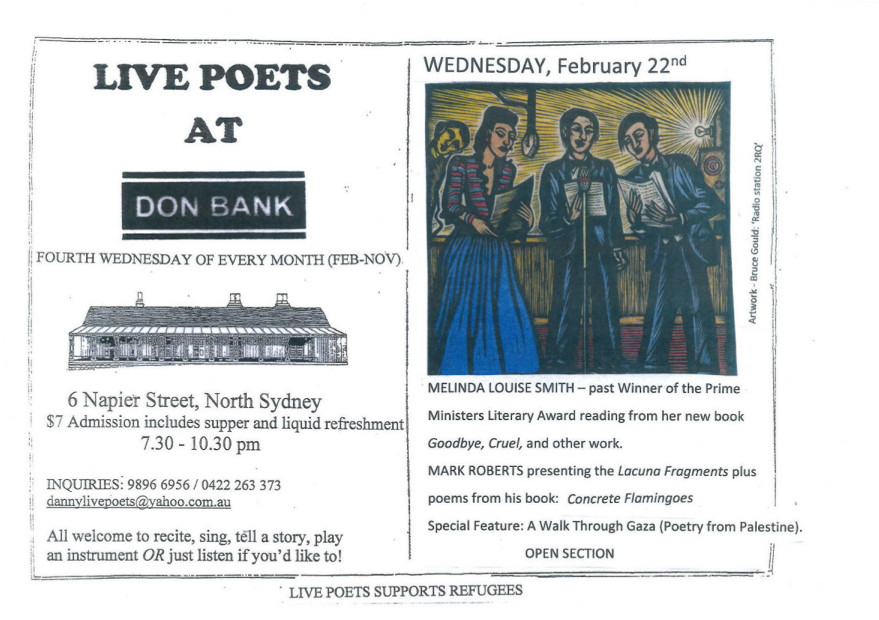
Mark Roberts, Melinda Louise Smith and A Walk Through Gaza (Poetry From Palestine) At Don Banks North Sydney

19 Feb

don-banks

I’m looking forward to reading with Melinda Louise Smith and listening to A Walk through Gaza (Poetry from Palestine) this coming Wednesday night at the Don Banks Museum, 6 Napier Street North Sydney from 7.30 pm. I will be reading poems from my new manuscript Lacuna as well as some from my last collection Concrete Flamingos. Many thanks to Danny Gardner for inviting me.


Sarah St Vincent Welch, Anna Couani and Mark Roberts to read at Rhizomic Poetry Wednesday 30th November

29 Nov

reading

I’m particularly excited to be reading on Wednesday night in Glebe with two of my favourite writers and very good friends, Anna Couani and Sarah St Vincent Welch at Mr Falcon’s (92 Glebe Point Road) as part of the regular Rhizomic Poetry Reading.


‘outcomes’ and ‘cutting the grass’ appear in the November 2016 issue of ‘The Basil O’ Flaherty’

17 Nov

The Basil O’ Flaherty is an interesting newish on-line journal run out of the US by  J.K. Shawhan. In the best tradition of small literary journals it was established by a writer wanting to create outlets for the sort  of writing and artwork she was interested in – 30 years ago it would have been gestetnered or photocopied, these days it is a free online journal.

Along with its normal editions The Basil O’ Flaherty is also devoting sections to feminist poetry and poems in translations. It will be interesting to see how these sections develop over the coming months.

My two poems in the current edition can be found at http://thebasiloflaherty.weebly.com/mark-roberts.html. While you are there you can check the archives for my prose piece ‘red’ which was published in the first edition back in March 2016 http://thebasiloflaherty.weebly.com/archives5.html

‘Shark’ – a block poem in Otoliths 43

6 Nov

My block-poem ‘Shark’ has appeared in the on-line journal Otoliths Issue 43. Otoliths is one of of those journals which flies a little under the radar but which has a rich history and continues to play an important role both locally and internationally. Otoliths is edited by the New Zealand born Mark Young who curently lives in Queensland and who has been publishing poetry for over 50 years. He describes the journal as publishing  “e-things, that is, anything that can be translated (visually at this stage) to an electronic platform”. As a result  Otoliths contains an interesting mix of poetry and prose ranging from the almost traditional to the experimental including some very fine visual poems.

I have described ‘Shark’ as a ‘block-poem’. It is a form that I have been playing around with a little recently where what would normally be a conventional prose poem is ‘forced’ into a contained space – a square, rectangle, circle etc. ‘Shark’ is the first of these poems that I have sent out and is based on a childhood memory of an old creek at the end of the street that had been encased in concrete and was referred to as “the canal”. It basically became the local dumping ground and filled up with car bodies, discarded washing machines and the like. By being forced into a column ‘Shark’ takes on the appearance of a traditional newspaper story where the importance of the story could be measured in column inches – but the actual text of ‘Shark’ retains its poetic origins.

‘Shark’ can be found at http://the-otolith.blogspot.com.au/2016/08/mark-roberts.html. While you are there make sure to lose yourself in the reach archive of work that can be found at the Otoliths site. If you haven’t been there before you are in for a treat.


The Disappearing Reappears with my Newcastle poems

1 Nov

red-roomI went through a literary hibernation for a number of years from the mid 1990s. There was an element of burn out involved, together with the pressures and joy of being involved in bringing up young children. The result being that for many years any writing I did was private and not intended for publication. A few years ago, however, I started thinking of re-engaging with the wider writing community. Around this time I saw a call for submissions from the Red Room Company for the first version of the The Disappearing project and decided to dive back in.

The Disappearing  was/is an intriguing project. Designed to be linked to place by mobile device or website, the project highlights what is being lost by means through poetry. I had a poem selected for that first Disappearing release. ‘Flood Watch’, which was about a relationship that had long disappeared, as recalled a Newtown that was also fast disappearing. The poem can be found here  http://disappearing.com.au/poem/flood-watch/.

The Disappearing has now been relaunched with a new website and more poets and poems. Among the bunch of new poems are two of my Newcastle poems which first appeared in the anthology A Slow Combusting Hymn: Poetry From and About the Hunter Region (edited by Jean Kent and Kit Kelen). These poems, which are based on my memory of two photographs taken by my grandfather in the 1950s, can be found at: http://disappearing.com.au/poem/photographs/

While you are at The Disappearing make sure you have a look around, there are some great poems about place and memory there and they are still looking for contributions.


‘Forgetting is So Long’ – Love Poetry by Australian Men

14 Oct

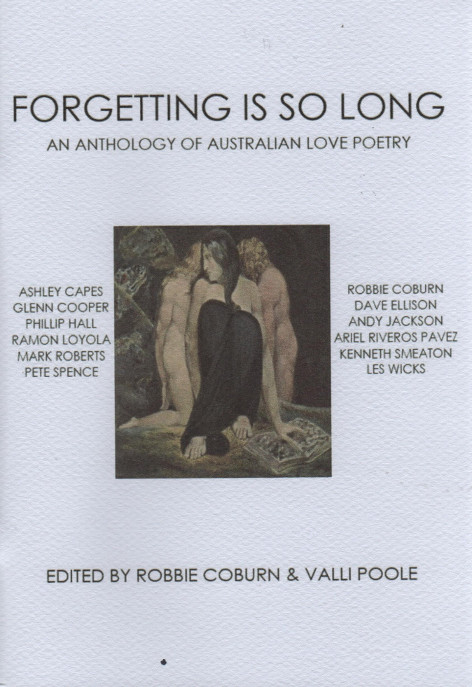
Forgetting is so Long: An Anthology of Australian Love Poetry edited by Robbie Coburn & Valli Poole. Blank Rune Press 2016


Love is so short, forgetting is so long.
………………………… – Pablo Neruda

forgetting-is-so-long-2

.

When we think of anthologies were generally think of larger books with lots of pages so it was exciting to be asked to contribute to a chapbook anthology of Australian love poems. Some years ago I had some poems in the Inkerman & Blunt Australian Love Poetry anthology. That was a huge, diverse and ultimately uneven anthology (as anthologies of that size tend to be). Forgetting is so Long is the opposite – it is a small, beautifully constructed chapbook and it features love poems by men. When I was submitted my poems to Robbie Coburn I was unaware that the anthology would be purely love poems by men but I have been pleasantly surprised by the result and the company in which my two poems have landed. There is a hint here of a different masculinity, something that deserves to be explored in greater depth.

Along with my work Forgetting is so Long contains poetry by Ashley Capes, Robbie Coburn, Glenn Cooper, Phillip Hall, Ramon Loyola, Pete Spence, David Ellison, Andy Jackson, Ariel Riveros Pavez, Kenneth Smeaton and Les Wicks. It is available from Collected Works Bookshop in Melbourne or you can contact the publisher for details on how to acquire a copy blankrunepress@gmail.com

.

.